


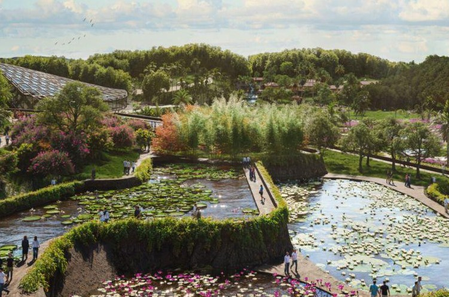
The Tamil Nadu government has launched a significant ecological restoration initiative by seeking proposals for the development of the Kadambur Biodiversity Conservation Park near Chengalpattu. This project falls under the Tamil Nadu Strengthening Coastal Resilience and Economy (TN-SHORE) program supported by the World Bank. Spanning 137.65 hectares, the Kadambur park aims to rejuvenate degraded landscapes, enhance climate resilience, and promote sustainable eco-tourism.
Planned as a versatile ecological area integrating conservation, education, and eco-friendly tourism, the Kadambur park seeks to transform unused land into a biodiversity-rich space. It aspires to serve as a conservation center and a public educational venue, contributing significantly to ecological security in the region. The project emphasizes the restoration of the Kadambur eri (lake) and its associated wetlands, crucial for local biodiversity and hydrology.
The Kadambur park’s master plan envisions recreating the five traditional Tamil Sangam landscapes, representing distinct ecological zones. Additionally, the park will include thematic gardens, a cloud-forest conservatory, herbarium, seed banks, cultural villages, cycling tracks, and eco-friendly visitor amenities. The initiative will be executed in two phases, with the initial phase focusing on surveys, soil testing, approvals, and removal of invasive species, while the subsequent phase will involve desilting, rainwater harvesting, wetland restoration, and construction of essential facilities.
To address environmental and social issues, the project incorporates an elaborate Environmental and Social Management Plan (ESMP). This plan outlines strategies for conservation, noise and dust control during construction, and protection of biodiversity in sensitive habitats. It also includes provisions for wildlife relocation, local employment, grievance redressal, and measures to prevent gender-based violence at project sites. The State Forest Department’s Chengalpattu Division will oversee project execution, with monitoring by the TN-SHORE State Project Management Unit and World Bank supervision.
Allocating Rs 32.70 lakh for ESMP implementation and Rs 12 lakh for monitoring, this initiative is poised to enhance biodiversity, bolster climate resilience, and establish the region as a sustainable nature-based tourism model.
