


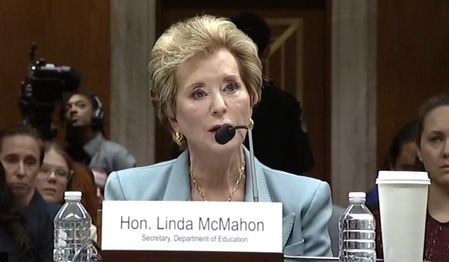
The Trump administration is intensifying efforts to address the soaring costs of college education, with Education Secretary Linda McMahon highlighting that 43 million Americans are burdened with a massive $1.7 trillion in student debt. McMahon defended significant student loan reforms during a session with the House Education and Workforce Committee, emphasizing that unrestricted federal lending has contributed to the inflation of tuition fees nationwide.
The discussion evolved into a heated debate on the administration’s higher education restructuring, particularly focusing on new restrictions on graduate student borrowing for fields like nursing, teaching, and social work. Democrats expressed concerns that these changes might exacerbate workforce shortages and push students towards expensive private loans.
Representative Joe Courtney of Connecticut criticized the administration for potentially making advanced nursing education less affordable at a time when there is a critical shortage of healthcare professionals. He pointed out that some graduate nursing programs already surpass the new federal loan limits.
McMahon refuted the accusations and stated that the reforms aim to compel universities to reduce tuition fees. She highlighted that some universities have already started lowering prices for graduate programs following the announcement of the new regulations.
The Education Secretary also advocated for the administration’s revamp of the federal student aid system, mentioning that the updated FAFSA application now takes around 35 minutes to complete, a significant improvement from the previous lengthy process. The administration has implemented stricter identity verification measures, preventing over $1 billion in fraudulent student aid disbursements, including schemes involving fake students and AI-generated applications.
Republicans on the committee lauded the reforms as essential for reinstating accountability in the student loan system. Committee Chairman Tim Walberg praised the simplified repayment programs and the return of “responsibility” to borrowers, criticizing what he described as unsuccessful loan forgiveness attempts during the Biden era.
However, Democrats accused the administration of limiting access to higher education for low-income individuals. Representative Ilhan Omar of Minnesota argued that the loan restrictions could push students towards private lenders instead of making education more affordable.
The ongoing debate reflects the significance of student debt as a major economic and political issue in the United States, particularly affecting younger Americans grappling with inflation, housing expenses, and escalating tuition costs. The Biden administration’s efforts towards broad student loan forgiveness have faced legal hurdles and opposition from Republicans.
The developments are closely monitored by Indian students, a substantial international student community in the US. Changes in federal loan policies, affordability of graduate programs, and education reforms tailored towards workforce needs could have lasting implications for foreign students pursuing higher education and specialized professional degrees in the US.
