


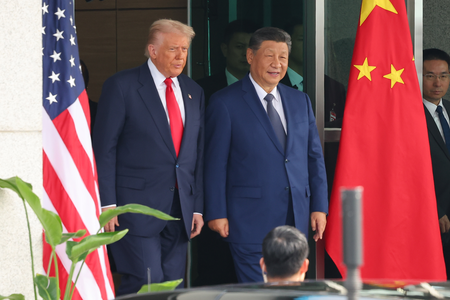
US President Donald Trump is set to travel to Beijing this week for discussions with Chinese President Xi Jinping. The agenda of the talks will focus on trade, investment, Iran, Taiwan, artificial intelligence, and security concerns, as confirmed by the White House. Trump’s visit will commence with his arrival in Beijing on Wednesday evening, followed by a welcome ceremony and a bilateral meeting with Xi scheduled for Thursday morning.
During the visit, the two leaders are expected to visit the Temple of Heaven in the afternoon, with Trump attending a state banquet in the evening. On Friday, Trump will engage in a bilateral tea session and working lunch with Xi before departing from China. Principal Deputy Press Secretary Anna Kelly emphasized the significance of the visit, stating that it goes beyond symbolism for President Trump, with a focus on rebalancing trade with China to prioritize American workers, farmers, and families.
The agenda includes discussions on establishing a US-China Board of Trade and a US-China Board of Investment. The Board of Trade will oversee government-to-government trade management in non-sensitive goods, while the investment board will serve as a platform for investment-related dialogues. Aerospace, agriculture, and energy are among the sectors where potential agreements may be explored during the talks.
Regarding trade, a senior US official mentioned the possibility of the Board of Trade covering trade volumes in the double-digit billions. The official dismissed reports of a substantial Chinese investment plan, clarifying that discussions have revolved around purchase commitments, particularly in agricultural goods and aircraft. On the topic of Iran, Trump is expected to address concerns with Xi, including China’s financial support to Iran and Russia, as well as issues related to dual-use goods.
The discussions may also extend to artificial intelligence, with US officials expressing security concerns in this rapidly evolving sector. There are considerations about establishing a communication channel between the two countries to address AI matters. In terms of Taiwan, US officials reiterated the existing policy stance, highlighting increased arms sales approvals to Taiwan under the current administration compared to previous years.
The visit occurs within the context of a complex US-China relationship marked by trade tensions, technology controls, Taiwan, cyber activities, and China’s international partnerships. The engagement between Washington and Beijing continues to navigate various challenges, including economic, security, and geopolitical issues.
