


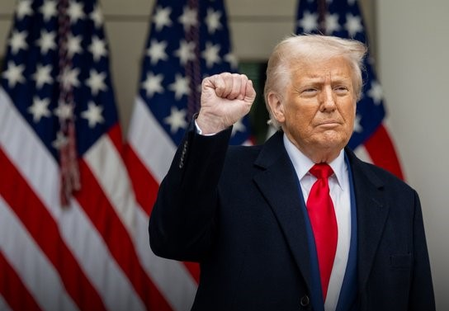
US President Donald Trump’s announcement of potential tariffs on eight European countries unless Denmark agrees to a deal concerning Greenland has triggered strong opposition from Nordic leaders and key European figures. Trump stated on social media that tariffs starting at 10 percent on February 1 would be imposed on goods from Denmark, Norway, Sweden, France, Germany, Britain, the Netherlands, and Finland, escalating to 25 percent by June 1 until an agreement is reached for the purchase of Greenland. Nordic leaders emphasized the need for dialogue over pressure in resolving disputes among allies.
Danish Foreign Minister Lars Lokke Rasmussen expressed surprise at the tariff threat and highlighted Denmark’s communication with the European Commission. Norwegian Prime Minister Jonas Gahr Store labeled the threats as “unacceptable,” emphasizing the importance of sovereignty for the Kingdom of Denmark. Finnish President Alexander Stubb advocated for resolving issues through discussions rather than coercion, warning of potential harm to transatlantic relations.
Swedish Prime Minister Ulf Kristersson rejected the tariff as “blackmail,” asserting Sweden’s stance against such pressure tactics and suggesting EU intervention. French President Emmanuel Macron condemned the tariff threat as “unacceptable” and pledged a united European response if the measures proceed. British Prime Minister Keir Starmer criticized the tariffs as inappropriate towards NATO allies and stressed the need for Greenland’s future to be determined by its people.
The German government announced close coordination with European partners to formulate a joint response. At the EU level, European Commission President Ursula von der Leyen and European Council President Antonio Costa cautioned that tariffs linked to Greenland could harm transatlantic relations. They reaffirmed Europe’s commitment to sovereignty and unity in the face of external pressures.
The situation reignited discussions on activating stronger trade defense mechanisms within the EU, including the Anti-Coercion Instrument (ACI). Bernd Lange, chair of the European Parliament’s Committee on International Trade, called for immediate ACI activation in response to Trump’s tariff threat, highlighting concerns over the use of tariffs as a political tool. Manfred Weber, chair of the European People’s Party, indicated that approval of the EU-US trade deal was currently unfeasible given the circumstances.
Cyprus, holding the EU’s rotating presidency, scheduled an emergency meeting to coordinate next steps among ambassadors from the EU’s 27 member states.
