


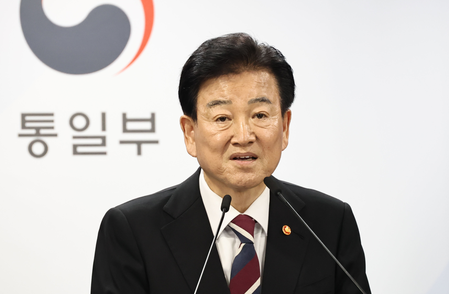
The unification ministry defended its recently released white paper against claims of violating the Constitution by explaining that the controversial ‘two-state’ language is part of broader peace initiatives on the Korean Peninsula.
Describing the ‘two-state’ language as an “implementation strategy,” the ministry stated that it aims to achieve the current administration’s goal of peaceful coexistence with North Korea. It emphasized that this strategy is crucial for institutionalizing peaceful coexistence between South and North Korea.
In response to concerns, the ministry clarified that the ‘two-state’ concept does not entail legal recognition of North Korea as a state. Instead, it involves respecting North Korea’s system and sovereignty while acknowledging its de facto statehood. The ministry highlighted that this concept does not equate to recognizing North Korea as a legal state.
The white paper, unveiled by the Lee Jae Myung government, outlines South Korea’s North Korea policy based on three key principles: respecting North Korea’s system, avoiding absorption-based unification, and refraining from hostile actions. It underscores Seoul’s pursuit of peaceful coexistence with North Korea while keeping eventual unification as a goal, considering the current reality of both Koreas existing as separate entities.
Addressing criticisms, the ministry assured that it would actively seek diverse opinions on such sensitive matters to ensure broad public engagement and discussion.
