


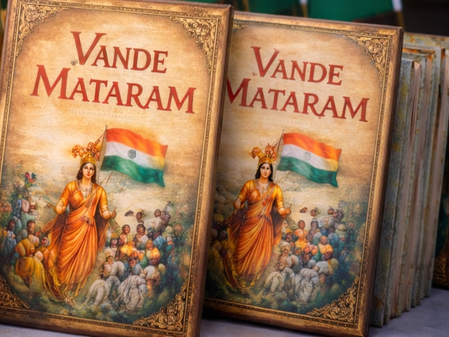
The Union government recently issued new guidelines outlining the official protocol for the rendition of India’s national song ‘Vande Mataram’. The ruling Trinamool Congress and the opposition CPI-M have voiced criticism against this move. Specifically, they objected to the directive that the complete official version of ‘Vande Mataram’, consisting of six stanzas and lasting around three minutes and 10 seconds, must be performed or played during major state occasions.
Both parties have labeled this provision as another instance of divisive politics. Trinamool Congress state vice-president in West Bengal, Jaiprakash Majumdar, expressed his disapproval, stating that such a directive is unwelcome from a government led by a political party whose leaders, he claimed, did not participate in the Indian freedom movement. He criticized the government for lecturing on patriotism despite not having a history of involvement in the struggle against British rule.
Majumdar highlighted the historical context of ‘Vande Mataram’, mentioning that in 1937, certain parts of the song were endorsed by Jawaharlal Nehru, India’s first Prime Minister, based on Rabindranath Tagore’s advice. However, only that portion was later recognized as the national song. He accused the BJP government of distorting history by attempting to exploit the verses of ‘Vande Mataram’ to sow religious divisions in society. Majumdar asserted that this was a deliberate ploy to undermine the Constitution and the unity of India.
Echoing these sentiments, CPI-M central committee member from West Bengal, Sujan Chakraborty, criticized the BJP for trying to create a new narrative around ‘Vande Mataram’ to divert attention from critical national issues. Chakraborty emphasized that Gurudev Rabindranath Tagore had deliberated on the significance and emotions associated with the song, implying that the current Union government had no authority to alter or discuss that historical context. He condemned the government for making unilateral decisions without considering the constitutional implications, especially during a time when the country is facing multiple crises on the international front.
