


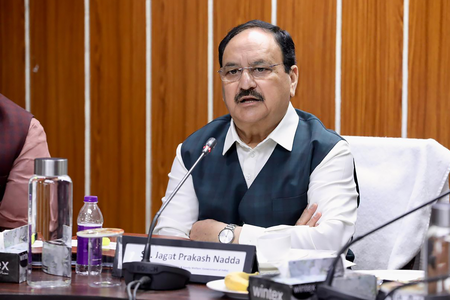
Union Health and Family Welfare Minister Jagat Prakash Nadda is set to introduce the Samagra Shishu Bal Swasthya Karyakram (SSBSK) during the 16th Conference of the Central Council of Health and Family Welfare (CCHFW) at Vigyan Bhawan. This initiative aims to enhance newborn and child health services in India, emphasizing comprehensive and quality healthcare for every child. The SSBSK program focuses on providing continuous home and community-based care from birth to 36 months of age, recognizing the crucial role of the first three years in child survival, growth, and development.
The SSBSK merges two existing community-based programs, Home-Based Newborn Care (HBNC) and Home-Based Care for Young Child (HBYC), into a unified national framework. By integrating these initiatives, SSBSK ensures a seamless continuum of care from birth through the early years, promoting child survival, nutrition, healthy growth, and early childhood development through a holistic approach. The program introduces a risk-stratified approach for ‘At-risk’ newborns and children, offering tailored follow-up with additional home visits based on their level of risk.
Under the SSBSK, ‘At-risk’ newborns will receive up to nine home visits within the first 42 days, while ‘At-risk’ children will have up to eight home visits until 36 months of age. Accredited Social Health Activists (ASHAs), Auxiliary Nurse Midwives (ANMs), Community Health Officers (CHOs), and Anganwadi Workers (AWWs) will conduct joint home visits to ensure continuity of care. Additionally, the program will introduce Well-Baby Sessions during Village Health, Sanitation, and Nutrition Days (VHSND) and monthly Shishu Shivir at Ayushman Arogya Mandirs for early identification and management of ‘At-risk’ children.
The SSBSK will incorporate post-partum maternal mental health screening as a structured component of community-based care and integrate nurturing care for Early Childhood Development (ECD) through responsive caregiving, early learning, play, child safety, and family engagement. Leveraging digital technologies like Decision-Support Systems (DSS) and child tracking applications, the program aims to enhance monitoring and continuity of care.
