


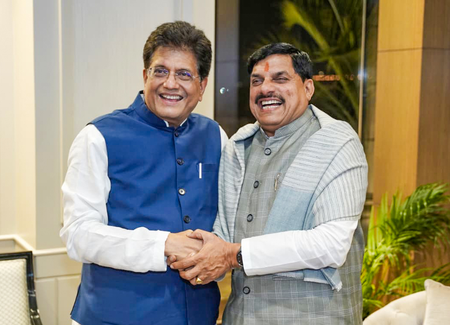
Union Commerce and Industry Minister Piyush Goyal met with Madhya Pradesh Chief Minister Mohan Yadav in Delhi to discuss enhancing industrial growth, investments, and job creation in the state. Simultaneously, a significant Rs 4,415.60-crore highway development project was sanctioned to boost economic activities in tribal-dominated districts of Madhya Pradesh.
Goyal highlighted that Madhya Pradesh is becoming a prime investment destination in India due to its business-friendly policies, upgraded infrastructure, and conducive investment environment. The Cabinet Committee on Economic Affairs, led by Prime Minister Narendra Modi, approved the upgradation and widening of key sections of National Highway-347B in Madhya Pradesh under the Hybrid Annuity Mode.
The approved project involves upgrading a 125.01-km section to a two-lane road with paved shoulders and widening a 108.643-km stretch from two to four lanes, totaling 233.653 km. This corridor will connect Betul, Khandwa, Khargone, and Barwani districts, forming a crucial part of the Betul–Khandwa–Vadodara route. The initiative aims to address sharp curves, traffic congestion, and enhance regional connectivity and socio-economic development.
The upgraded highway is expected to improve travel speed, reduce journey time, enhance road safety, and lower fuel consumption and vehicle operating costs. It will provide seamless connectivity to major economic, social, and logistics hubs, linking six PM Gati Shakti economic nodes and five key social nodes, including aspirational and tribal districts. The project is estimated to create around 19.50 lakh person-days of direct employment during its construction phase.
Chief Minister Mohan Yadav welcomed the project approval, emphasizing its potential to accelerate growth in tribal-majority districts and create employment opportunities. He expressed gratitude to Prime Minister Narendra Modi and Union Road Transport and Highways Minister Nitin Gadkari for approving this transformative infrastructure project. The highway project is set to strengthen industrial connectivity, enhance logistics efficiency, and support the state’s investment attraction and job creation strategy.
