


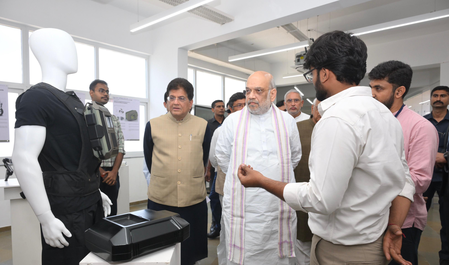
Union Commerce and Industry Minister Piyush Goyal emphasized the importance of “design thinking” in governance, citing Prime Minister Narendra Modi and Union Home Minister Amit Shah as examples. Goyal stated that structured planning, innovation, and entrepreneurship play a crucial role in India’s development model. He highlighted the significance of design, innovation, and research for India’s progress towards “Viksit Bharat @2047.”
Goyal praised Modi and Shah for their meticulous planning and structured execution of programs, describing their approach as a model to follow. He emphasized that design encompasses more than just aesthetics or products; it reflects an entire mindset. Goyal pointed out that developed economies are built on innovation, design thinking, and entrepreneurship rather than natural resources or population.
The minister referenced India’s historical traditions of design and innovation, citing examples such as ancient Indian architecture, Vastu principles, mathematics, surgical science from the time of Sushruta, and the Iron Pillar in Delhi. He noted that colonial rule had weakened India’s culture of innovation but highlighted the country’s efforts to reconnect with its strengths. Goyal stressed the importance of design, innovation, and research in shaping India’s future as a developed and prosperous nation.
Goyal commended Gujarat as an “entrepreneurial powerhouse” under Chief Minister Bhupendra Patel, mentioning the state’s blend of modern sectors like semiconductors, electronics, defense, and aerospace with traditional industries such as gems, jewelry, diamonds, and textiles. He expressed confidence in the entrepreneurial spirit of the people of Gujarat and highlighted the role of the Innovation and Incubation Centre in fostering collaboration between students, faculty, and industries.
The minister emphasized the need for “out-of-the-box thinking” and collaboration to address challenges effectively. He underscored that innovation should focus on improving people’s lives, creating jobs, enhancing productivity, and strengthening the economy. Goyal outlined India’s future economy, which would rely on artificial intelligence, automation, skilled manpower, creative design, and technology-driven manufacturing, moving beyond dependence on low-cost labor alone.
