


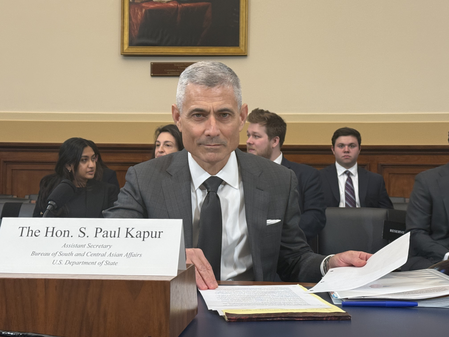
US Assistant Secretary of State for South and Central Asia, S. Paul Kapur, highlighted India’s significance in South Asia, stating that its large population and strategic location make it a crucial anchor for the region. He emphasized the importance of a strong and independent New Delhi to prevent any single power from exerting coercive influence over the Indo-Pacific. Kapur stressed the need for the United States to work with partners to maintain a free and open region.
Kapur underscored the US objective of preventing any hegemon, particularly China, from dominating or imposing leverage on the region. He noted that India’s strategic autonomy aligns with Washington’s interests and helps in promoting a free and open Indo-Pacific. The testimony followed a recent trade agreement between President Donald Trump and Prime Minister Narendra Modi, signaling a strengthening of bilateral ties.
House subcommittee chair Congressman Bill Huizenga praised India as a vital strategic partner, highlighting the specifics of the US-India trade deal. He emphasized India’s role in countering Beijing’s influence and ensuring regional stability. Kapur outlined strategic capacity-building approaches, including defense cooperation, targeted investments, and diplomacy, to enhance the US-India partnership.
Democratic Congressman Ami Bera emphasized bipartisan continuity in US policy towards India, noting the robust nature of the bilateral relationship across various sectors. Kapur also mentioned the importance of cooperation through platforms like the quad, enabling unique connections with like-minded partners. The partnership between the US and India has expanded significantly over the past two decades, particularly in defense, energy, and technology cooperation.
