


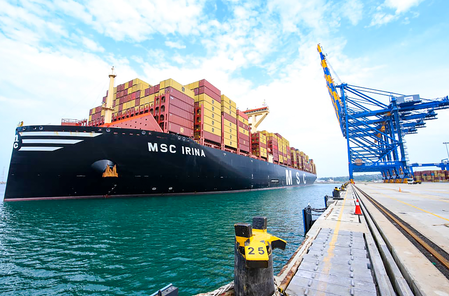
Vizhinjam International Seaport, operated by Adani Ports and Special Economic Zone Ltd (APSEZ) in partnership with the Kerala government, is swiftly becoming one of India’s rapidly expanding container transhipment centers. The port achieved significant milestones in January 2026, showcasing its growth and integration with global shipping networks. Notably, it recorded its highest monthly container throughput of 1,23,092 twenty-foot equivalent units (TEUs) and handled 62 vessels during the month, the most since its commercial operations began.
The port’s performance highlights a remarkable increase in productivity and execution capabilities within just over a year of operation. Vizhinjam has climbed to the 83rd position globally among container ports by volume, handling 740 vessels and 1.57 million TEUs since its inception. It has proven its ability to accommodate large vessels, including ultra large container vessels (ULCVs), positioning itself as a significant player in the region.
Vizhinjam’s success can be attributed to its advanced technology and workforce readiness, including the deployment of a Made-in-India vessel traffic management system and the introduction of women automated crane operators. The port’s natural advantages, such as deep waters, minimal littoral drift, and a three-kilometer breakwater, allow for year-round operations with minimal dredging requirements. Its strategic location near key shipping lanes positions it as a viable alternative to established hubs like Colombo, Dubai, Singapore, and Port Klang.
APSEZ’s recent announcement of a Rs 16,000-crore investment for Phase 2 expansion signifies Vizhinjam’s growth trajectory. By 2029, the port’s capacity is expected to increase from 1 million TEUs to 5.7 million TEUs. As Vizhinjam continues to expand and solidify its position in India’s maritime landscape, it plays a crucial role in the country’s ambition to capture a larger share of global container transhipment traffic.
