
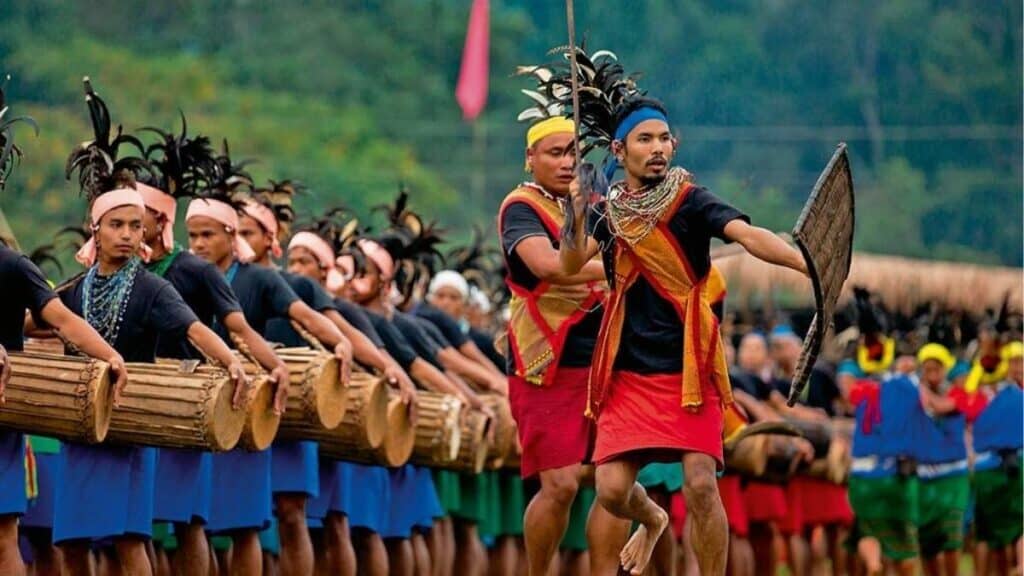
Wangala, also known as the Festival of the Hundred Drums, is the most important annual harvest festival of the Garo tribe. Celebrated with thunderous drumming, vibrant attire, and ceremonial offerings, it is a post-harvest thanksgiving dedicated to Misi Saljong, the Garo sun god of fertility and abundance. The festival marks the end of the agricultural season, the onset of winter, and the community’s gratitude for the year’s harvest. Observed primarily in Meghalaya, Assam, and Nagaland in India — and in parts of Bangladesh — Wangala is a living expression of Garo identity, spirituality, and cultural pride.
Wangala is the premier festival of the Garo people, a Tibeto-Burman ethnic group indigenous to the Garo Hills of Meghalaya, northeastern India. The festival is a post-harvest thanksgiving to Misi Saljong — the sun god of fertility — for blessing the community with a good harvest. It signals the end of agricultural labor and the beginning of winter.
Celebrated across Meghalaya, Assam, Nagaland, and the Greater Mymensingh region of Bangladesh, Wangala brings together entire villages for days of ritual, drumming, dance, feasting, and communal celebration. Its defining feature — the spectacle of hundreds of drummers playing the long, oval Dama drum in unison — has earned it the name Festival of the Hundred Drums.
Wangala reinforces community bonds, preserves Garo ethnic identity, and honors the tribe’s deep connection to the land. It is both a sacred religious observance for Songsarek (animist) Garos and a shared cultural celebration for the broader Garo community.
When Is Wangala Celebrated in 2026?
Wangala 2026 falls on Friday, 6 November 2026.
Unlike fixed-date festivals, Wangala does not follow the Gregorian calendar. Its timing is determined by the close of the harvest season, and different villages in Meghalaya, Assam, Nagaland, and Bangladesh set their own dates between September and December. The peak period of celebration falls in October and November, once the fields have been harvested.
The state-sponsored Hundred Drums Festival at Asanang in West Garo Hills is the most prominent public celebration and is typically held over three days during this window.
Wangala 2026 Dates in India: The main Wangala observance falls on Friday, 6 November 2026. Multi-day village celebrations may begin one to two days earlier or extend through the weekend, depending on the community.
Table of Contents
Wangala In USA, Canada, Australia, New Zealand, UK, UAE, Singapore 2026 Dates
Wangala falls on Friday, 6 November 2026.
Wangala falls on Friday, 6 November 2026.
Wangala falls on Friday, 6 November 2026.
Wangala falls on Friday, 6 November 2026.
Wangala falls on Friday, 6 November 2026.
Wangala falls on Friday, 6 November 2026.
Why Wangala Dates Change Every Year
Wangala is tied to the agricultural harvest cycle of the Garo Hills, not a fixed point in the Gregorian or Hindu lunar calendar. Each village determines its own celebration date based on when the harvest is complete, local custom, and community consensus. This means dates vary by village, district, and region — typically falling anywhere between late September and mid-December, with November being the most common month for large-scale celebrations.
Other Names and Regional Identities
Wangala is the festival’s standard name across all Garo-speaking communities.
The Hundred Drums Festival — the name of the state-sponsored public event held at Asanang, West Garo Hills — is its most recognized alternative name, reflecting the massed drumming tradition at the heart of the celebration.
The full name of the deity honored is Misi-A-Gilpa-Saljong-Galapa, also known as Misi Saljong or Pattigipa Ra’rongipa. In journalistic and tourism contexts, the festival is also called the Garo Harvest Festival or Wangala Harvest Festival.
In Bangladesh, where large Garo communities live in the Greater Mymensingh region, the festival is observed under the same name, Wangala, maintaining a shared cultural identity across the border.
Origins, History, and Legends
Wangala is rooted in the Songsarek belief system — the indigenous animist religion of the Garo people. Songsareks worship a pantheon of gods and nature spirits, with Misi Saljong as the supreme force behind agricultural fertility and the cycle of seasons. After the harvest, communities gathered to thank the sun god before the onset of winter, giving rise to the rituals and dances that form the core of Wangala.
The traditions have been passed down orally across generations as a sacred living practice. In remote Songsarek villages such as Sadolpara in West Garo Hills, the original form of Wangala — with the Kamal (priest) performing prescribed rites in the Nokma’s home — is still observed faithfully.
The modern Hundred Drums Festival was first organized on 6 and 7 December 1976 at Asanang, about 18 kilometres from Tura. Since then, it has grown into an annual state-sponsored event drawing troupes from across Garo Hills, Karbi Anglong, Tripura, and Bangladesh, with significant prize money for the best performers.
Cultural and Spiritual Significance
Wangala holds meaning on multiple levels. Agriculturally, it marks the close of the harvest — a collective exhale after months of field labor. Spiritually, it reaffirms the Garo community’s relationship with Misi Saljong and the natural world. Socially, it draws villages together, strengthening ties and a shared sense of who the Garo people are.
For Songsarek Garos, Wangala is a sacred religious observance, a precise renewal of the covenant between the tribe and the old gods. For the broader Garo community — including those who have converted to Christianity — it has evolved into a cultural celebration of ethnic pride, artistic heritage, and community belonging.
This dual meaning has allowed Wangala to endure and expand even as the community itself has changed, making it both a spiritual anchor and a living cultural institution.
Prayers and Religious Observances
Wangala observances are opened by the Kamal, the village priest, with two rituals performed inside the home of the Nokma (the village chieftain). The first is Rugala — the pouring of rice beer as a formal offering to Misi Saljong. The second is Cha·chat So·a, the burning of incense to mark the festival’s commencement and invite divine blessings.
These rites formally sanctify the celebration and express the community’s thanks to the sun god. Nothing else begins before the Kamal completes them. Prayers seek a continued blessing of fertility, good harvests, and well-being for the village in the year ahead.
In traditional Songsarek villages, these rituals are conducted with full ceremonial precision. In the public Hundred Drums Festival format, cultural performances take center stage, but the ritual significance of the occasion remains acknowledged and respected.
Celebrations Across India
The heartland of Wangala is the West Garo Hills district of Meghalaya, where dozens of villages observe the festival between October and December. Celebrations typically run two to three days and involve communal prayer, drumming, dancing, feasting, and inter-village participation.
In Tura, the cultural and commercial capital of the Garo Hills, Wangala is prominently observed. The Christian Girls’ Higher Secondary School teaches the Wangala dance as part of its official curriculum, and student troupes from Tura are a regular presence at the Hundred Drums Festival.
In Assam, Garo communities in Goalpara and neighboring districts observe Wangala with village-level ceremonies and dances. In Nagaland, Garo cultural troupes perform the Wangala dance at the Hornbill Festival each November, bringing the tradition to a national and international stage.
The Hundred Drums Festival at Asanang remains the largest public celebration, drawing tourists, competitive dance troupes, sports events, food stalls, and art exhibitions over three days.
Participation Across Religions in India
Wangala originates in the Songsarek animist tradition but has become a shared cultural event for the religiously diverse Garo community. A significant portion of Garos converted to Christianity during the 19th and 20th centuries, and Christian Garos today participate widely in Wangala as a celebration of ethnic identity, even if the purely religious dimensions are interpreted differently from the Songsarek perspective.
At the Hundred Drums Festival, performers may be Songsarek, Christian, or non-religious. The emphasis is on cultural expression, artistic performance, and community pride rather than exclusive religious practice. This inclusive character has made Wangala relevant for younger, urban Garos who may not practice the Songsarek faith but feel a strong connection to their tribal heritage through dance, music, and dress.
Non-Garo communities across Meghalaya and the Northeast also attend as spectators and participants in the cultural events, drawn by the music, color, and community spirit.
How Wangala Is Celebrated Outside India
The largest diaspora observance of Wangala outside India takes place in Bangladesh, where Garo communities in the Greater Mymensingh region celebrate with traditional dances and local ceremonies. Bangladesh-based troupes have actively participated in the Hundred Drums Festival at Asanang, maintaining cultural ties across the border.
In the Indian diaspora, Wangala is less widely known than pan-Indian festivals, but northeastern Indian cultural organizations in cities like New York, London, Sydney, and Singapore increasingly feature Garo cultural performances — including Wangala dances — at community events. These presentations help preserve tribal identity and introduce the tradition to second-generation diaspora members unfamiliar with life in the Garo Hills.
Gifting Traditions
Traditional Wangala gifting centers on rice beer, agricultural produce, and food shared freely between households and villages. The exchange of food and drink reflects the community’s gratitude for the harvest and its spirit of mutual generosity.
In contemporary settings, traditional Garo textiles have become meaningful festival gifts — handwoven blankets, shawls, and garments featuring the bold geometric patterns characteristic of Garo weaving traditions. These carry cultural significance and serve as a way of honoring heritage.
Within diaspora and urban communities, sharing homemade festival foods or gifting handcrafted items connected to Garo culture is a growing practice that helps maintain a sense of cultural connection across distances.
Wangala Foods and Culinary Traditions
Food and drink are central to Wangala. Chi, the traditional Garo rice beer, is both a sacred offering to Misi Saljong — poured during the Rugala ritual — and a drink shared communally throughout the celebration. Its presence is essential to both the spiritual and social dimensions of the festival.
Pork dishes are the centerpiece of the festive feast, often prepared with bamboo shoots and local herbs in the smoky, hearty style of Garo hill cooking. Rice — the crop being celebrated — appears in multiple forms, from steamed rice to fermented preparations and as the base for Chi.
Other festive foods include smoked meats, fermented fish, foraged leafy vegetables, and dishes cooked in bamboo cylinders over fire. These flavors are tied directly to the landscape of the Garo Hills, making the shared meal itself an act of gratitude for the harvest.
Music, Art, and Cultural Expression
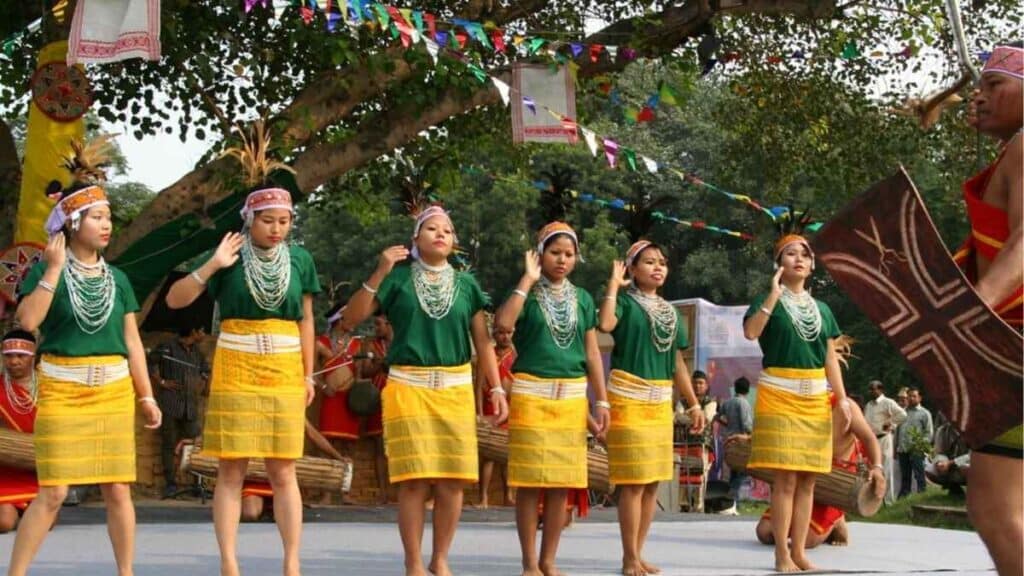
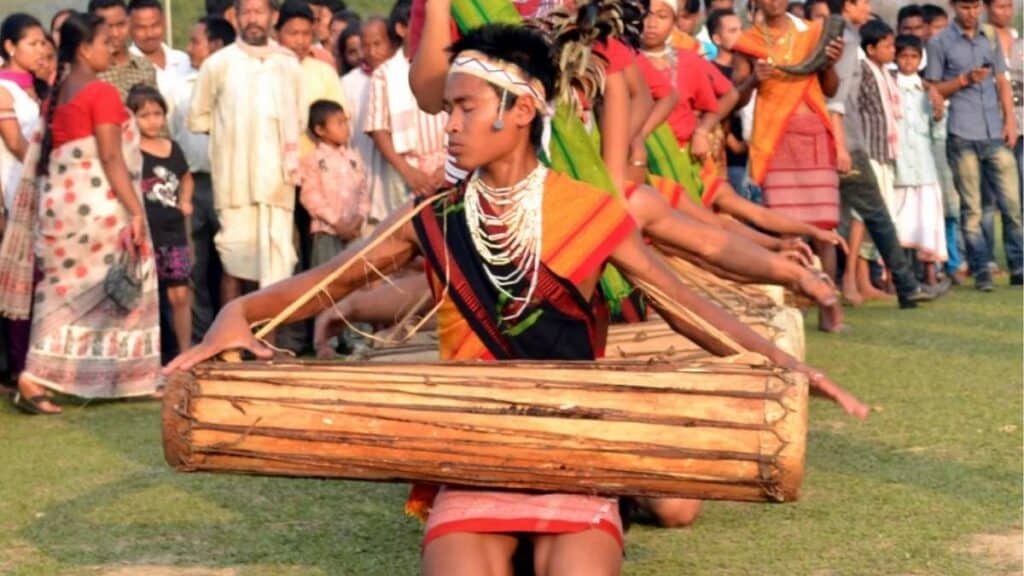
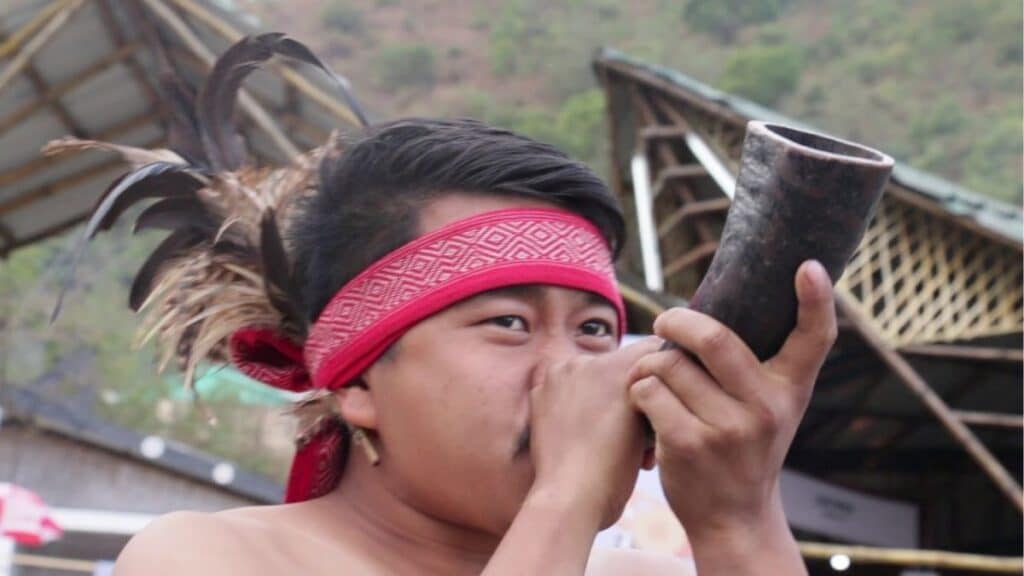
Music and dance are the soul of Wangala. The Dama — a long, oval-shaped drum — is the festival’s defining instrument, and the sight and sound of hundreds of Dama players performing together gives the Hundred Drums Festival its name. Men play the Dama alongside bamboo flutes, gongs, and assorted brass instruments. Women form graceful formations around the Nokma, moving in layered rows.
The Dama Gogata, performed on the final day of the festival, is the climactic dance — men and women moving together in full ceremonial attire to the layered rhythms of drums, flutes, and brass. Other performances include Katta Doka (a traditional form of tribal narrative singing or rapping), Dani Doka (a sung description of Wangala), and the Chambil Mesaa, or Pomelo Dance.
Ceremonial dress is equally important. Participants wear colorful garments — Dakmanda, Daksari, or Gando — and the iconic feathered headgear called Do’me. The visual spectacle of costumed dancers and massed drummers has made Wangala one of northeastern India’s most distinctive and celebrated folk traditions.
Modern Observance and Evolving Practices
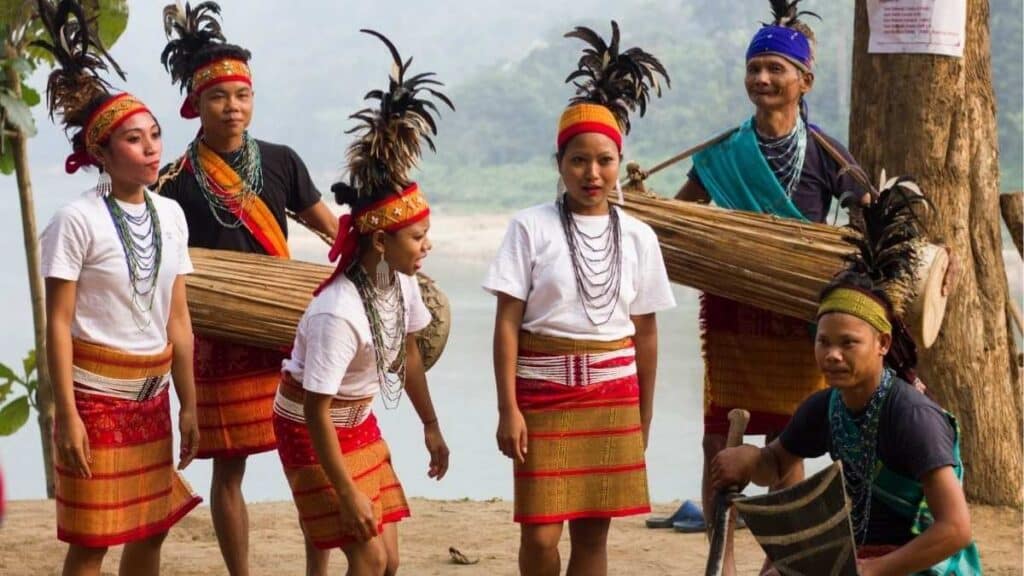
Wangala has evolved considerably without losing its essential character. The shift from purely Songsarek observance to a broader cultural celebration has allowed it to stay relevant for Christian Garos and urban youth who connect with their tribal identity through dance, music, and dress rather than through the old religion.
In cities, the festival is often condensed to a single day, with performances and community gatherings replacing multi-day village ceremonies. Schools across the Garo Hills formally teach the Wangala dance, ensuring younger generations learn the tradition even in academic settings.
The state-sponsored Hundred Drums Festival has brought international tourists, media attention, and cultural recognition to Wangala, helping position it as a flagship expression of Meghalaya’s tribal heritage. This visibility has also created economic opportunities for local artisans, musicians, and food vendors.
To wish someone during Wangala, a warm “Happy Wangala!” is widely used. You can also say “May the harvest be plentiful” or offer greetings that celebrate community and abundance — the spirit the festival is built on.
Cultural Reflection
Wangala endures because it speaks to something essential in the Garo relationship with land, community, and memory. In the beat of the Dama drum, the arc of a Do’me feather, and the shared cup of Chi poured for Misi Saljong, the Garo people renew their connection to the hills that shaped them. As the community navigates urbanization, religious change, and diaspora life, Wangala remains a living anchor — not a relic of the past, but a celebration that gathers each generation back to the rhythm of the hundred drums.