


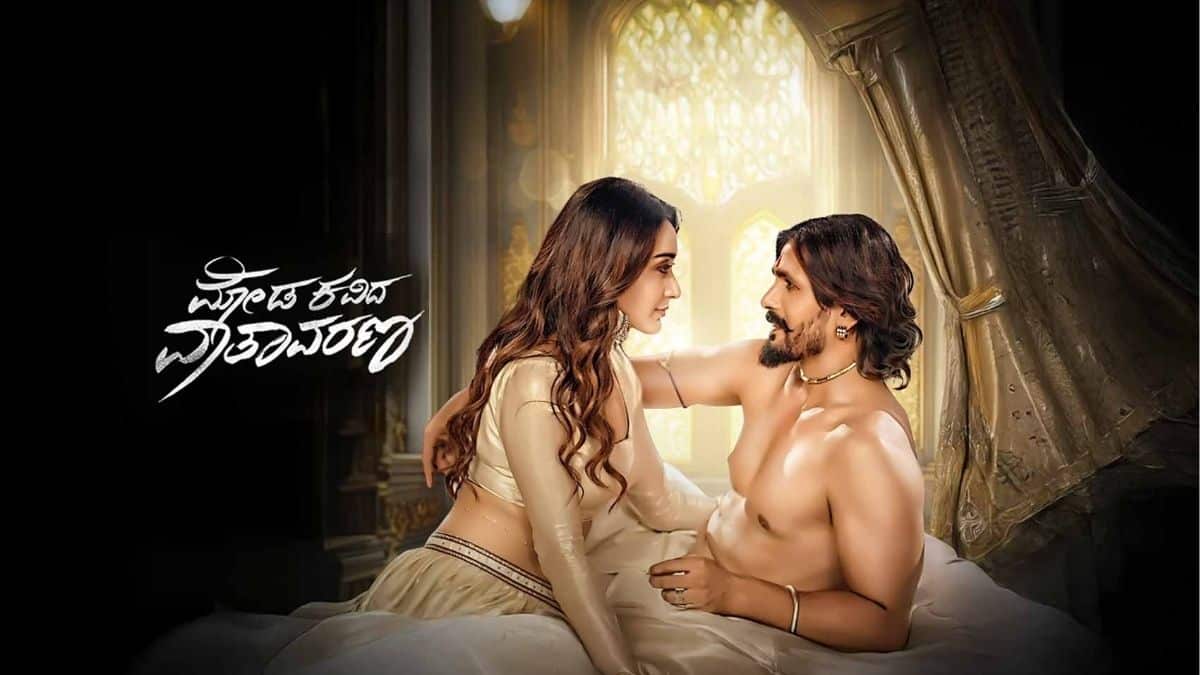
Director Simple Suni returns with Moda Kavida Vaatavarana, a Kannada film that chooses mood over mechanics and emotion over exposition — and in doing so, crafts one of the most evocative theatrical experiences Sandalwood has offered this year. Released on 26 June 2026, the film introduces fresh face Sheelam M Swamy alongside Moksha Kushal and Saathvika in a story that blends monsoon romance with quiet psychological dread. If you enjoy cinema that breathes, observes, and trusts its audience, Moda Kavida Vaatavarana is exactly the kind of film you have been waiting for.
Moda Kavida Vaatavarana is a slow-burning, atmosphere-first Kannada drama from director Simple Suni that masterfully fuses romance, psychological unease, and mythological subtext into a deeply immersive cinematic experience. The film introduces a compelling new hero in Sheelam M Swamy, supported by outstanding work from Moksha Kushal and Saathvika, while Judah Sandy’s soulful music and Santhosh Rai Pathaje’s misty, rain-drenched cinematography elevate every frame. Suni’s signature trust in tone over plot may test viewers seeking conventional thrills, but for those willing to surrender to its mood, the film rewards with emotional richness and a resonant final message rooted in the Yayathi myth. A must-watch for fans of thoughtful, character-driven Kannada cinema.
Cast & Crew
| Role | Name |
|---|---|
| Director | Simple Suni |
| Producers | Mysuru Ramesh, Shreerangaraju, Lokesh Belawadi, Goa Ramesh |
| Production Banner | Ram Movies |
| Music Composer | Judah Sandy |
| Cinematographer | Santhosh Rai Pathaje |
| Lead Cast | Sheelam M Swamy, Moksha Kushal, Saathvika |
| Supporting Cast | Rishi, Rekha S Prasad, Dhananjaya Didaga |
| Lyricist | Suni |
| Certificate | U/A |
| Language | Kannada |
| Release Date | 26 June 2026 |
Plot Summary
The story opens with a father narrating a tale to his daughter, followed by a stage performance inspired by the mythological legend of Yayathi — an old king who trades his age for youth. This ancient fable of desire and consequence quietly echoes throughout the narrative, never explained overtly, but always present in the background.
Three central characters emerge: Cherish (Sheelam M Swamy), a warm and socially easy-going young man whose very name is a blend of his parents’; Sathvika (Saathvika), a driven software engineer balancing love and ambition; and Souparnika (Moksha Kushal), a quieter soul on the cusp of an arranged engagement with Dhanu. On the surface, their lives seem ordinary. But subtle disruptions begin to appear — a repeated phone number, a message that shouldn’t exist, a detail that appears where it doesn’t belong. The film reveals that the intrusion is not physical but deeply digital and behavioural: someone has already entered their lives without breaking a single door. As Cherish and Sathvika’s romance blooms against a backdrop of hills and rain, Souparnika finds herself caught in a web of dread she cannot name. The spider web motif that runs through the film — delicate at a distance, binding up close — says it all.
Performances
Sheelam M Swamy as Cherish
Sheelam M Swamy makes an assured and quietly captivating debut as Cherish. There is no overreach, no performance anxiety — just a young actor who understands the world his director has built and inhabits it with natural ease. His long working relationship with Suni translates into a performance that is attuned to the film’s pace and emotional register. Sheelam does not seek the spotlight; he earns it through restraint, and every glance and gesture reveals a character who is as much an observer of his world as a participant in it. It is a debut worth celebrating.
Moksha Kushal as Souparnika
Moksha Kushal is quietly riveting as Souparnika, the character around whom the film’s central tension revolves. She communicates an entire inner world through small, precise choices — a hesitation before speaking, a look held a moment too long, a smile that does not quite reach the eyes. Kushal avoids melodrama entirely, and that discipline makes Souparnika’s growing sense of unease all the more affecting. Her performance is a study in understated emotional intelligence, and she more than holds her own alongside her more established co-stars.
Saathvika as Sathvika
Saathvika brings warmth, wit, and genuine emotional complexity to Sathvika. Her character is caught between the pull of love and the demands of career ambition, and Saathvika navigates this tension with impressive ease. She brings lightness to the film’s romantic scenes while ensuring that Sathvika’s vulnerability feels authentic and earned. Her chemistry with Sheelam is engaging and natural, grounding the film’s gentler emotional core even as darker undercurrents build around it.
Rishi (Special Appearance)
Rishi’s appearance is a delightful surprise that adds another layer of energy to the proceedings. Even in limited screen time, his presence registers strongly, and his role serves the narrative purpose it is intended to. It is the kind of cameo that fans will cheer for, and Rishi delivers with the confident ease of an actor who knows exactly how to make a moment count.
Rekha S Prasad
Rekha S Prasad plays a pivotal role through whom the film’s central mystery finds its resolution. She handles this responsibility with quiet conviction, making her character’s revelation feel both credible and emotionally significant. Rekha brings a composed authority to her performance that anchors the film’s climactic emotional turn.
Dhananjaya Didaga as Dhanu
Dhananjaya Didaga brings steady support to the ensemble as Dhanu, Souparnika’s arranged match. His performance is measured and sincere, lending the relationship dynamic the authenticity it needs to feel grounded. Even within the film’s more atmospheric storytelling, Didaga ensures his character has a clear and felt presence.
Also Read: Tera Mera Nata Review (2026): A Heartfelt Tale of Love, Family, and Sacrifice
Technical Craft
Direction — Simple Suni
Simple Suni once again demonstrates that he is among Kannada cinema’s most distinctive voices when it comes to atmosphere and tone. His direction on Moda Kavida Vaatavarana is deliberate and assured — he resists the urge to push the thriller elements into genre territory, instead keeping the film rooted in emotional ambiguity. His use of the Yayathi mythological frame is elegant and non-intrusive, and his understanding of digital-age fear — surveillance not through cameras but through habits, routines, and digital trails — feels remarkably contemporary. Suni proves yet again that great cinema doesn’t need to shout.
Cinematography — Santhosh Rai Pathaje
Santhosh Rai Pathaje’s camerawork is one of the film’s greatest strengths. The rain, mist, and quiet hills are rendered with a beauty that never tips into postcard aesthetics — instead, they feel alive with the emotional states of the characters. The cinematography does not merely capture a location; it creates a world where visibility is always partial, always uncertain, and always meaningful. Every frame is a mood painting.
Music — Judah Sandy
Judah Sandy’s score is a perfectly calibrated companion to the film’s emotional journey. His music never overpowers the narrative — it supports, suggests, and occasionally pulls back entirely to let silence do its work. The songs are melodious and textured, with lyrics by Suni himself adding emotional depth. The Yayathi Yayathi track in particular stands out as a piece of music that captures longing and surrender in equal measure.
Editing
The editing maintains the film’s deliberate, meditative rhythm. While some may find certain portions could have been paced more briskly, the editorial choices are clearly intentional — they prioritise emotional immersion over narrative momentum, in keeping with Suni’s vision for the film.
Strengths & Weaknesses
Strengths
- Masterful atmospheric filmmaking by Simple Suni
- Standout debut by Sheelam M Swamy
- Compelling, restrained performances from all three leads
- Gorgeous cinematography by Santhosh Rai Pathaje
- Thematically rich Yayathi mythological subtext
- Contemporary and relevant treatment of digital-age stalking and surveillance
- Judah Sandy’s evocative and soulful music
Weaknesses
- The deliberate pacing may test viewers accustomed to faster-moving narratives
- Mood occasionally takes precedence over plot momentum, leaving some threads feeling slightly underexplored
Final Verdict: ⭐⭐⭐⭐½ (4.5/5)
Moda Kavida Vaatavarana is Simple Suni at his most confident and most poetic. It is a film that chooses to trust its audience — to sit with ambiguity, feel the rain, and let the spider’s web settle before pulling at it. Sheelam M Swamy’s debut is one of the most natural and assured first appearances from a Kannada hero in recent years, and his female co-stars, Moksha Kushal and Saathvika, match him beat for quiet beat. With Santhosh Rai Pathaje’s hauntingly beautiful frames and Judah Sandy’s soul-stirring music completing the picture, this is a film that earns its emotional payoff. It may not answer every question it raises, but it asks the right ones — and sends you out into the world still wondering.
What is the age rating/certification of Moda Kavida Vaatavarana?
The film has been certified U/A by the Central Board of Film Certification (CBFC), meaning it is suitable for general audiences with parental guidance recommended for children.
Is Moda Kavida Vaatavarana suitable for family viewing?
Yes, the film is largely suitable for family audiences, particularly those who enjoy thoughtful, emotionally layered cinema.
Is Moda Kavida Vaatavarana based on a true story?
No, Moda Kavida Vaatavarana is not based on a true story. It is an original fictional narrative, though it draws thematic inspiration from the ancient Sanskrit myth of Yayathi, weaving its philosophical ideas about desire, sacrifice, and consequence into the modern story.
