


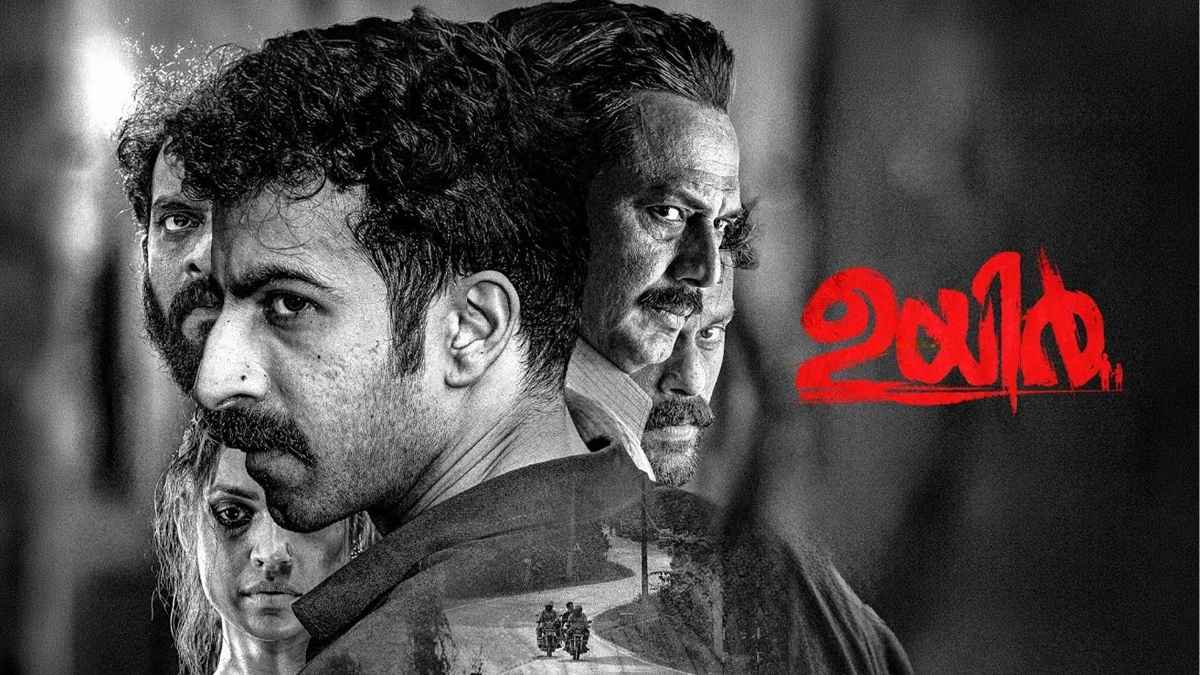
Malayalam cinema has long excelled at the crime investigation genre, and veteran director M. Padmakumar’s latest offering, UYiR, steps into that tradition with a story rooted in real-life incidents. Released on June 26, 2026, the film stars Roshan Mathew as a probationary sub-inspector navigating a haunting case of a woman found dead in an abandoned well — a mystery that unravels across Kerala, Karnataka, and Mumbai. With a strong emotional undercurrent about missing children and unresolved trauma, UYiR is a film that wears its heart on its sleeve and ultimately delivers a moving, human-centred experience driven by committed performances and a poignant finale.
UYiR is a slow-burn Malayalam crime drama that earns its emotional pay-off through patient storytelling and a remarkably grounded lead performance by Roshan Mathew. The film takes its time building the world of probationary SI Ajeeb Rahman, weaving his personal trauma of a missing sister into a murder investigation that gradually reveals heartbreaking truths about missing children in India. While the pacing demands patience and the narrative structure leans conventional in its middle portions, the film finds its true voice in its emotionally charged final act — delivering a climax that is both realistic and deeply affecting. Anchored by sincere performances across the board and a socially relevant theme that lingers long after the credits roll, UYiR is a rewarding watch for fans of human-driven crime dramas.
Cast & Crew
| Role | Name |
|---|---|
| Director | M. Padmakumar |
| Story | Anshad S |
| Screenplay & Dialogues | Nikhil K. Menon, Shaji Maarad |
| Producer | Santhosh Thrivikraman (WOW Cinemas) |
| Distributor | Century Films |
| Music | Manikandan Ayyappa |
| Cinematography | Ajay David Kachappilly |
| Editing | Ranjan Abraham |
| Lyrics | Shibu Chakravarthy, Santhosh Varma |
| Roshan Mathew | Ajeeb Rahman (Probationary SI) |
| Shruthy Menon | Shobha (Victim) |
| Baiju Santhosh | ASI Joy |
| Athulya Chandra | Shehna (Ajeeb’s wife) |
| Vinoth Sagar | Raju (Prime Suspect) |
| Saiyami Kher | Special Appearance |
| Vineeth Thattil David | Supporting Role |
| Shaju Sreedhar | Supporting Role |
| Sreekanth Murali | Supporting Role |
| Divya M. Nair | Supporting Role |
Plot Summary
UYiR opens in 2010 with a young boy travelling on a train through Maharashtra with his family. His little sister goes missing during the journey and is never found — a wound that the boy carries silently into adulthood. Years later, that boy is Ajeeb Rahman (Roshan Mathew), a Sub-Inspector serving his probationary period at the Dharmadom Police Station in Kannur.
When the decomposed body of a woman is discovered in an abandoned well in the area, Ajeeb and his colleague ASI Joy (Baiju Santhosh) are assigned the case. The deceased is soon identified as Shobha (Shruthy Menon), a manual labourer. What initially appears to be a straightforward suicide begins to take darker turns as the investigation deepens — particularly when the duo tracks down Shobha’s estranged husband Raju (Vinoth Sagar), whose account of events raises far more questions than it answers. The trail takes Ajeeb across Karnataka and into the labyrinthine lanes of Mumbai, as a shocking truth about Shobha’s missing children slowly emerges — one that strikes uncomfortably close to Ajeeb’s own unhealed past.
Also Read: Tera Mera Nata Review (2026): A Heartfelt Tale of Love, Family, and Sacrifice
Performances
Roshan Mathew as Ajeeb Rahman
Roshan Mathew is the soul of UYiR, and he inhabits the role of Ajeeb with quiet, controlled intensity that makes every scene he occupies feel lived-in and real. His portrayal is built on restraint — flickering panic attacks triggered by the sound of trains, subtle shifts in his eyes when the case begins mirroring his personal tragedy — all rendered with an authenticity that reminds you why Mathew is one of the most compelling actors in Malayalam cinema today. He makes Ajeeb’s professional earnestness and emotional vulnerability feel like two sides of the same coin, and it is his performance that carries the film through its slower stretches and powers the emotional crescendo of the finale with genuine feeling.
Shruthy Menon as Shobha
Shruthy Menon takes on the challenging role of Shobha — a character who exists primarily through the memory of others — and brings her to life with quiet, dignified grace. Working largely through flashback sequences with minimal dialogue, Menon communicates Shobha’s quiet suffering and maternal love through expression and physicality alone. It is a demanding performance that requires her to make a lasting impression without the benefit of conventional screen time, and she accomplishes this with considerable skill. Her Shobha becomes the moral centre of the film — a woman whose story demands to be told, and Menon tells it beautifully.
Baiju Santhosh as ASI Joy
Baiju Santhosh brings warmth and dependable energy to the role of Joy, Ajeeb’s senior colleague and partner throughout the investigation. His easy chemistry with Roshan Mathew gives the film some of its most naturally flowing scenes, and he grounds the procedural elements with a reassuring steadiness. Santhosh’s screen presence adds texture to the investigative dynamic, making Joy a character whose support feels genuine and whose role in the narrative feels earned.
Athulya Chandra as Shehna
Athulya Chandra brings a quiet radiance to the role of Shehna, Ajeeb’s supportive wife, infusing the domestic scenes with warmth that offers essential emotional contrast to the grim investigation at the film’s centre. Her portrayal is understated yet meaningful — Shehna is the emotional anchor Ajeeb returns to, and Chandra ensures that anchor feels real. She handles the personal moments between the couple with natural ease and contributes significantly to the film’s emotional texture.
Vinoth Sagar as Raju
Vinoth Sagar delivers a layered and compelling performance as Raju, the prime suspect whose shifting versions of events keep both the investigators and the audience on edge. He navigates the character’s moral ambiguity with confidence, making Raju simultaneously menacing and pitiable. Sagar commands the screen in his key scenes and ensures that the investigation’s central tension — the question of what truly happened — remains engaging every time he appears.
Saiyami Kher
Saiyami Kher makes a memorable special appearance in UYiR, bringing her trademark screen presence to a role that adds an additional dimension to the film’s broader emotional canvas. Even within a limited appearance, she leaves an impression — a testament to her calibre as a performer.
Vineeth Thattil David, Shaju Sreedhar & Sreekanth Murali
The supporting ensemble rounds out UYiR‘s world with commendable authenticity. Vineeth Thattil David, Shaju Sreedhar, and Sreekanth Murali each bring their characters to life with focused, purposeful performances that keep the film grounded in the gritty reality of police work and small-town life. Their collective presence ensures the world of the film feels populated and believable.
Divya M. Nair
Divya M. Nair delivers a sincere and noteworthy contribution to the ensemble, bringing depth to her supporting role and adding to the film’s emotional richness. Her scenes are crafted with care and she responds to that craft with a performance of genuine sensitivity.
Technical Craft
Direction — M. Padmakumar
M. Padmakumar, the director behind acclaimed Malayalam films like Joseph and Vasthavam, brings a measured hand to UYiR. His direction is most effective in the film’s emotional sequences, where he allows the performers the space to breathe and lets the weight of the story accumulate organically. The multi-location narrative — spanning Kannur, Karnataka, Coorg, Palakkad, and Mumbai — is handled with competent assurance, and the film’s grounded, real-life-inspired atmosphere is a direct result of his directorial vision.
Cinematography — Ajay David Kachappilly
Ajay David Kachappilly’s camera work lends UYiR a restrained, earthy visual quality that suits the film’s tone. Known for his work on Garudan and Porinju Mariam Jose, Kachappilly captures the textures of both rural Kerala and the urban sprawl of Mumbai with an honest, unfussy eye. The muted colour palette is a deliberate stylistic choice that underscores the film’s somber emotional register.
Music — Manikandan Ayyappa
Manikandan Ayyappa’s music is one of UYiR‘s most consistent technical strengths. His background score is carefully calibrated to the emotional beats of the narrative, never overwhelming the drama but consistently deepening it. The original songs, in particular, stand out as genuinely moving compositions — with Tamil lyrics penned by Niranjan Bharathi, a fourth-generation descendant of the legendary poet Subramania Bharati, adding literary resonance to the musical experience.
Editing — Ranjan Abraham
Veteran editor Ranjan Abraham keeps the film’s multi-chapter structure coherent and navigable, ensuring that the non-linear elements of the narrative click into place with clarity. The editing is at its strongest in the film’s final act, where the rhythm of cuts builds momentum toward the climax effectively.
Strengths & Weaknesses
Strengths
- Roshan Mathew’s career-best-calibre lead performance anchors the film throughout
- A deeply moving, realistic and emotionally resonant final act
- Socially significant subject matter around missing children in India, rooted in real incidents
- Manikandan Ayyappa’s evocative background score and original songs
- Strong ensemble cast bringing authenticity to every corner of the narrative
- Impressive multi-location production spanning five distinct regions
Weaknesses
- The mid-section pacing could benefit from tighter editing
- The social theme around the missing children takes time to move to the foreground
- Some domestic sequences between Ajeeb and Shehna feel repetitive in the second act
Final Verdict: ⭐⭐⭐⭐ 4 / 5 Stars
UYiR is ultimately a film about what drives a person to seek justice — not just for strangers, but for the ghost of someone they have never stopped mourning. Director M. Padmakumar and his team have crafted a sincere, emotionally honest crime drama that draws its power from real life and delivers its message through committed performances rather than cinematic spectacle. Roshan Mathew’s nuanced portrayal of Ajeeb Rahman is the kind of work that stays with you, and the film’s final thirty minutes are as moving as Malayalam crime cinema has offered in recent years. UYiR rewards patient viewers with a deeply human story — and that, ultimately, is its greatest strength.
What is the age rating / content rating of UYiR?
UYiR carries a UA16+ certification in India, indicating it is suitable for audiences aged 16 and above.
Is UYiR suitable for family or children’s viewing?
Due to its UA16+ rating and its subject matter — which includes a murder investigation, themes of child disappearance, and emotional trauma — UYiR is not recommended for young children.
Is UYiR based on a true story?
Yes. UYiR is based on real-life incidents, with the story credit given to the actual police officer whose experiences form the foundation of the film. Co-writer Shaji Maarad is himself a serving police officer and co-writer of the internationally acclaimed film Ela Veezha Poonchira, lending the screenplay an authentic ring of real-world procedural detail.
