
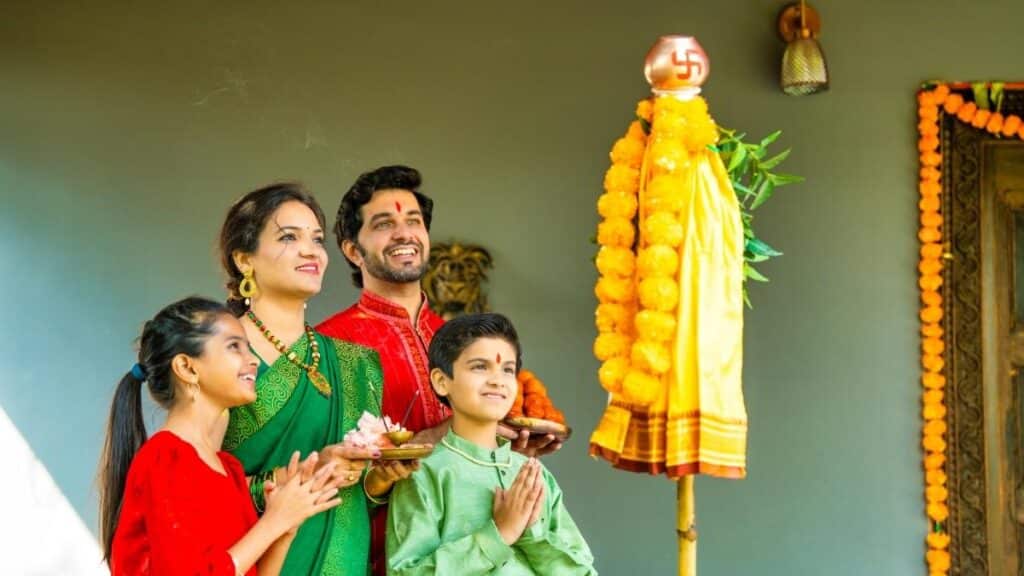
Gudi Padwa is one of the most vibrant and joyously celebrated festivals of Maharashtra, popularly known as the Marathi New Year. Observed at the arrival of spring, Gudi Padwa symbolizes victory, renewal, and the beginning of a new cycle of life. Rooted in ancient Hindu traditions, the festival marks the first day of the lunisolar month of Chaitra — a time of harvest, hope, and fresh starts.
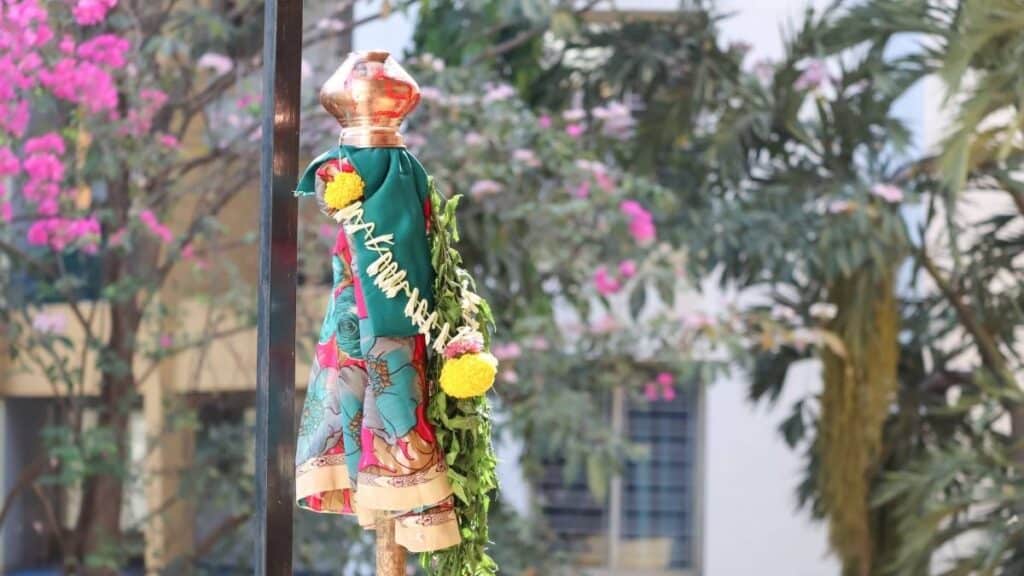
The spiritual heart of Gudi Padwa is the raising of the Gudi — a bright ceremonial flag made of silk cloth, topped with an inverted copper or silver pot, adorned with neem and mango leaves, and hoisted high on a bamboo pole at the entrance of every home. This act of raising the Gudi is a public declaration of victory, prosperity, and divine blessings for the year ahead.
Gudi Padwa is primarily celebrated by Maharashtrian and Konkani Hindu communities across India and the world. On the same lunisolar date, the festival is also observed as Ugadi in Karnataka, Andhra Pradesh, and Telangana; as Cheti Chand by the Sindhi community; and as Navreh by Kashmiri Pandits — making it a shared new year for millions of people across India and the global Indian diaspora.
When Is Gudi Padwa Celebrated in 2026?
Gudi Padwa is celebrated on Chaitra Shukla Pratipada — the first day of the bright fortnight of the Hindu month of Chaitra, which typically falls in March or April.
Gudi Padwa in India 2026 Date
Gudi Padwa will be celebrated on Thursday, March 19, 2026 in India.
- Pratipada Tithi Begins: 6:52 AM IST on March 19, 2026
- Pratipada Tithi Ends: 4:52 AM IST on March 20, 2026
This marks the beginning of Marathi Shaka Samvat 1948.
The exact date varies each year based on the lunisolar Hindu calendar, making Gudi Padwa a movable festival rather than a fixed-date event.
Table of Contents
Gudi Padwa In USA, Canada, Australia, New Zealand, UK, UAE, Singapore 2026 Dates
Gudi Padwa on Thursday, March 19, 2026
- Pratipada Tithi Begins – 09:22 PM on Mar 18, 2026
- Pratipada Tithi Ends – 07:22 PM on Mar 19, 2026
Gudi Padwa on Thursday, March 19, 2026
- Pratipada Tithi Begins – 09:22 PM on Mar 18, 2026
- Pratipada Tithi Ends – 07:22 PM on Mar 19, 2026
Gudi Padwa on Friday, March 20, 2026
- Pratipada Tithi Begins – 12:22 PM on Mar 19, 2026
- Pratipada Tithi Ends – 10:22 AM on Mar 20, 2026
Gudi Padwa on Thursday, March 19, 2026
- Pratipada Tithi Begins – 01:22 AM on Mar 19, 2026
- Pratipada Tithi Ends – 11:22 PM on Mar 19, 2026
Gudi Padwa on Thursday, March 19, 2026
- Pratipada Tithi Begins – 05:22 AM on Mar 19, 2026
- Pratipada Tithi Ends – 03:22 AM on Mar 20, 2026
Gudi Padwa on Friday, March 20, 2026
- Pratipada Tithi Begins – 09:22 AM on Mar 19, 2026
- Pratipada Tithi Ends – 07:22 AM on Mar 20, 2026
Why Does the Date of Gudi Padwa Change Every Year?
Gudi Padwa is celebrated based on the Hindu lunisolar calendar, not the Gregorian calendar. It falls on Chaitra Shukla Pratipada, which shifts every year relative to the Gregorian calendar.
Since lunar months are shorter than solar months, Gudi Padwa’s date moves each year and typically falls between late March and mid-April. Timing also depends on the moon’s position and local sunrise, which is why ritual timings vary slightly by location.
Gudi Padwa Other Names and Regional Identities
One of the most remarkable aspects of Gudi Padwa is that the same astronomical event — Chaitra Shukla Pratipada — is celebrated across multiple Indian linguistic communities under different names, each with their own traditions and stories.
These are the widely used names for Gudi Padwa:
- Gudi Padwa — Standard Marathi name, used by Maharashtrian Hindus in Maharashtra and globally.
- Pādvo — Konkani name used by Konkani Hindus in Goa, Kerala, and Mangalore.
- Samvatsar Padvo — Formal Konkani name used by Hindu Konkanis of Goa and the diaspora.
- Ugadi — Kannada name celebrated in Karnataka; also the Telugu name celebrated in Andhra Pradesh and Telangana.
- Cheti Chand — Sindhi name marking the birthday of Jhulelal, patron deity of the Sindhi community.
- Navreh — Kashmiri name celebrated by Kashmiri Pandits in Jammu and Kashmir and the diaspora.
In the diaspora, Marathi New Year is commonly used in community communications to make the festival more accessible. Cultural organizations often use Hindu New Year as an umbrella term reflecting the day’s shared significance across communities.
It is worth noting that Gudi Padwa is not the universal Hindu New Year. In Gujarat, the new year falls on Bestu Varas, the day after Diwali. In Tamil Nadu, Punjab, Assam, and Odisha, the solar-based new year falls in mid-April as Puthandu, Vaisakhi, Bihu, and Pana Sankranti respectively.
The Origins, History, and Legends of Gudi Padwa
Gudi Padwa is one of the oldest celebrated festivals of Maharashtra, with its origins rooted in ancient Hindu scriptures and traditions. The festival finds mention in classical texts including the Brahma Purana, which associates this day with the very beginning of cosmic time.
The Shalivahan Legend
The most widely celebrated legend of Gudi Padwa is that of King Shalivahan of Paithan, who defeated the invading Huns and returned victorious to his kingdom on this day. His people celebrated by raising a Gudi — a victory flag — outside their homes. This tradition of hoisting the Gudi continues to this day as an act of cultural memory and collective pride. Shalivahan is also credited with establishing the Shalivahan Shaka calendar, which enters its 1948th year in 2026.
The Brahma Creation Myth
According to the Brahma Purana, it was on Chaitra Shukla Pratipada that Lord Brahma began creating the universe and set time in motion, making this day the cosmic anniversary of creation itself. The Gudi raised at each home symbolizes Brahmadhwaj — Brahma’s flag — invoking blessings of abundance and new beginnings.
Lord Rama’s Return
Many Maharashtrian traditions also associate Gudi Padwa with the return of Lord Rama to Ayodhya after 14 years of exile and his victory over Ravana. The Gudi is raised as a symbol of Rama’s triumphant homecoming — a celebration of dharma’s victory over adharma.
Historically, Gudi Padwa also marked the arrival of spring and the end of the rabi harvest season, connecting its spiritual meaning to the agricultural rhythms of the land. Over centuries, it evolved from a religious observance into a social and cultural celebration that promotes victory, renewal, joy, and community.
Gudi Padwa: Cultural and Spiritual Significance
Gudi Padwa is a festival that symbolizes victory, renewal, and the triumph of good over evil. Spiritually, it represents the beginning of cosmic time, divine blessings for the year ahead, and the power of devotion and righteousness. Culturally, Gudi Padwa is one of the strongest expressions of Marathi identity — a festival that connects language, history, mythology, and the land of Maharashtra into a single joyous celebration.
A deeply meaningful tradition of the festival is the ritual consumption of neem leaves mixed with jaggery, tamarind, and coriander seeds on Gudi Padwa morning. This mixture — intentionally bitter, sweet, sour, and astringent all at once — is a philosophical reminder that the new year holds all flavours of experience, and we enter it with acceptance and equanimity. This same wisdom is embedded in Ugadi’s Pacchadi, reflecting a shared philosophy across India’s western and southern communities.
Marking the arrival of spring, Gudi Padwa also signifies growth, abundance, and hope for the new agricultural season. More than a religious festival, it is a celebration of cultural pride, community togetherness, and the enduring belief that every new year brings the promise of victory and renewal.
Gudi Padwa Prayers and Religious Observances
Gudi Padwa prayers and rituals are performed to invite divine blessings, purify the home and self, and begin the new year with spiritual intention.
Abhyanga Snan
The day begins before sunrise with Abhyanga Snan — a ritual oil bath using sesame or coconut oil, prescribed in Ayurvedic tradition to purify the body and prepare one spiritually for the new year.
Raising the Gudi
The central ritual of the day is the raising of the Gudi. The ceremonial flag is installed at the right side of the main entrance of the home, facing the street, and formally worshipped with flowers, kumkum, and prayers invoking Lord Brahma, Lord Vishnu, and the family deity. Many families also visit temples, particularly Shiva temples in rural Maharashtra, where communities carry the Gudhi Kavad together in a ceremonial procession.
Panchang Reading
Families perform puja at home and participate in the reading of the new year’s Panchang — the astrological almanac that announces the new Samvatsara, auspicious dates, and the year’s predictions. Whether observed at home or in temples, Gudi Padwa rituals emphasize devotion, gratitude, and spiritual renewal.
Chaitra Navratri Begins
Gudi Padwa also marks the beginning of Chaitra Navratri — nine days of worship dedicated to Goddess Durga. This convergence of the new year and Navratri makes the day especially powerful for spiritual new beginnings.
How Gudi Padwa Is Celebrated Across India
While the essence of Gudi Padwa remains consistent, its expressions vary widely across regions.
Maharashtra
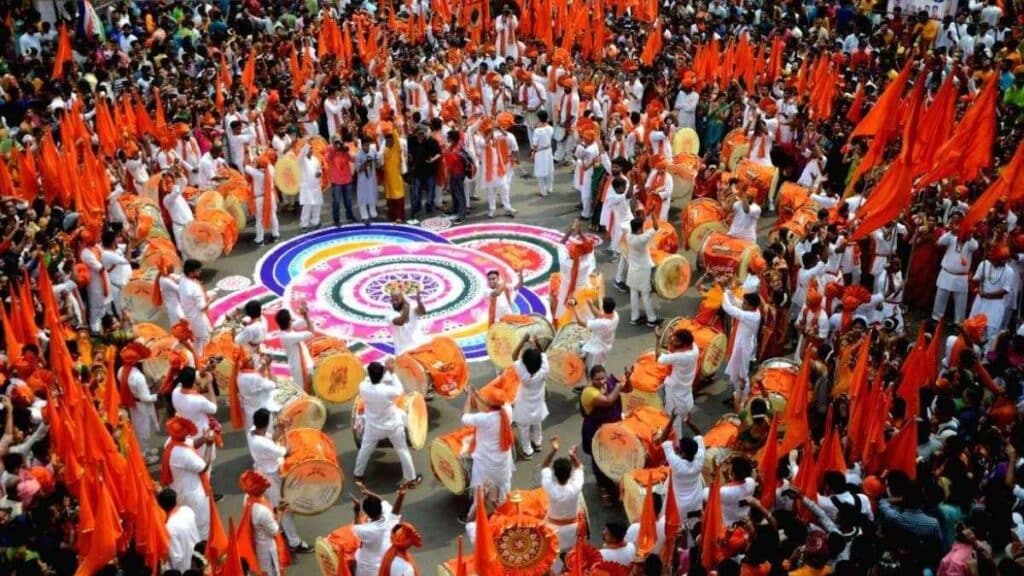
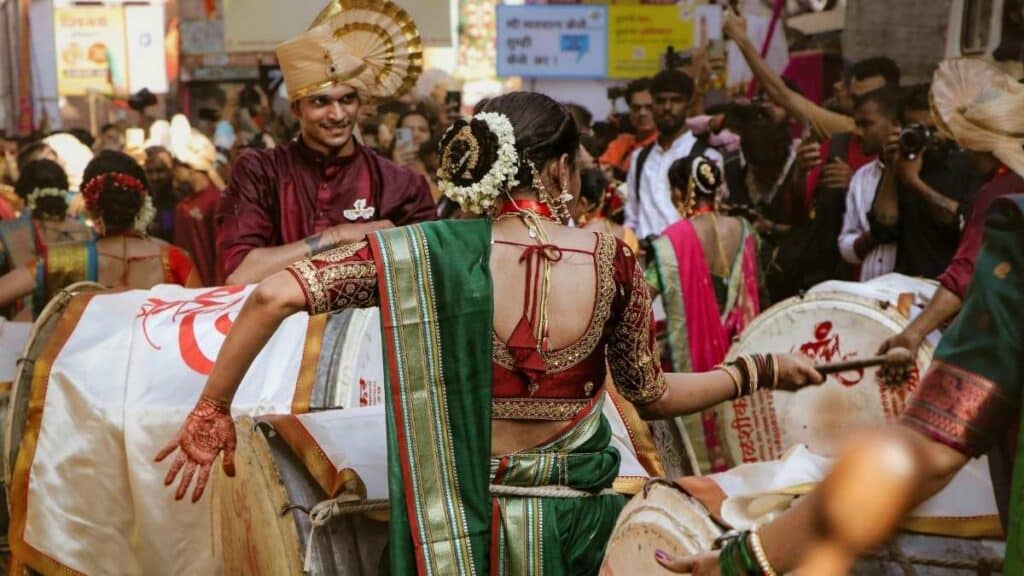
In Maharashtra, Gudi Padwa is a public holiday celebrated with the raising of the Gudi at sunrise, family prayers, traditional foods, and the iconic Shobha Yatra — a grand festive procession where thousands march in traditional Marathi attire through decorated streets with music and dance. Mumbai, Pune, Nashik, and Aurangabad hold some of the largest celebrations.
Goa and the Konkan Coast
Konkani Hindus celebrate the day as Samvatsar Padvo, blending Maharashtrian traditions with the region’s distinct Konkani cultural identity, folk music, and cuisine.
Karnataka and Telangana — Ugadi
The same date is celebrated as Ugadi, with the ceremonial preparation and consumption of Ugadi Pacchadi at its centre, along with temple visits, new clothes, and family gatherings.
Sindhi Community — Cheti Chand
For the Sindhi community, this day is Cheti Chand — the birthday of Jhulelal — celebrated with community prayers and processions honouring their patron deity.
Kashmiri Pandits — Navreh
Kashmiri Pandits observe the day as Navreh, preparing a special ritual plate the night before and viewing it at dawn as an auspicious vision for the new year.
Participation Across Religions in India
Gudi Padwa is celebrated not only by Hindus but by people of many communities across Maharashtra, making it a truly inclusive cultural festival. Neighbours of different faiths — Muslims, Christians, Buddhists, and Jains — join in wishing each other well, participating in neighbourhood celebrations, and sharing in the festive sweets of the day.
Maharashtra’s significant Buddhist community, including Navayana Buddhists following Dr. B.R. Ambedkar’s teachings, also participates in the cultural aspects of Gudi Padwa, particularly in urban areas, as the festival has come to represent a shared Maharashtrian cultural identity that belongs to all who call Maharashtra home.
By encouraging joy, generosity, and shared celebration, Gudi Padwa serves as a reminder that festivals can unite people across communities through common values of renewal, hope, and togetherness.
How Gudi Padwa Is Celebrated Outside India
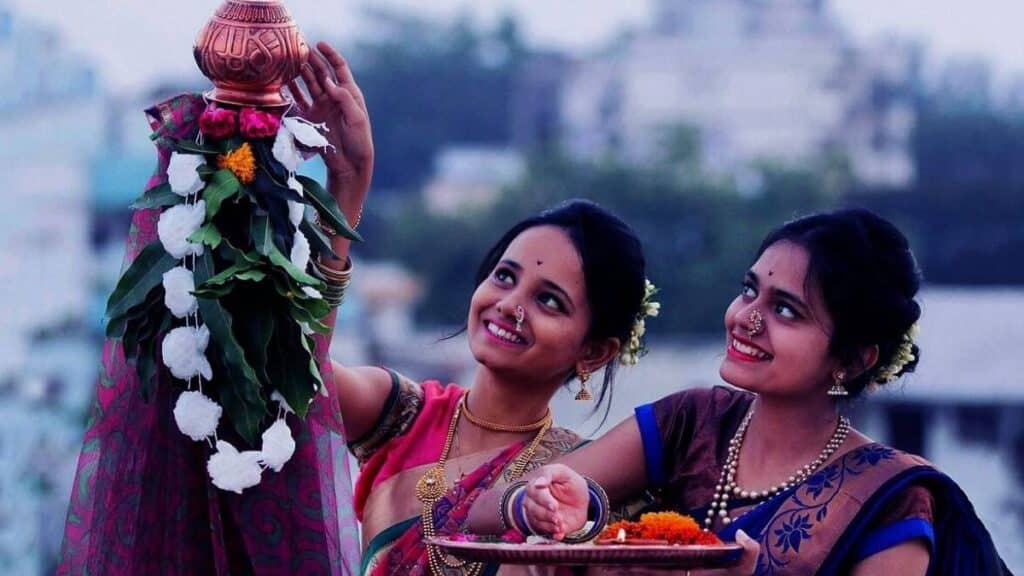
Indian diaspora communities across the United States, Canada, the UK, Australia, the UAE, and beyond celebrate Gudi Padwa through:
- Community events and cultural programs organized by Marathi Mandals
- Temple gatherings with special puja and prasad distribution
- Community potlucks featuring traditional Gudi Padwa foods
- Shobha Yatra-style processions in traditional Marathi attire
- School and university events organized by Indian student associations
- Online and hybrid events including virtual Panchang readings and cooking demonstrations
These celebrations help second-generation Indians stay connected to Maharashtrian heritage while introducing non-Indians to the richness of Marathi culture and the philosophy of the festival.
Gudi Padwa Gifting Traditions
Gudi Padwa gifting is a joyful tradition that symbolizes love, new beginnings, and shared prosperity. Giving something new on this day is considered auspicious and believed to invite good fortune through the year.
Traditional gifts include new clothes — particularly navvari sarees, paithani sarees, and kurta-pyjamas — given to children and elders as a mark of love and blessing. Boxes of traditional Maharashtrian sweets, silver or copper puja items, and fresh flowers are also commonly exchanged between families and neighbours.
Today, eco-friendly and thoughtful gifts have become popular, including organic neem products, traditional jaggery, and Maharashtrian spice mixes. In diaspora communities, Paithani sarees and authentic Maharashtrian sweets ordered directly from India are among the most cherished Gudi Padwa gifts.
Gudi Padwa Foods and Culinary Traditions
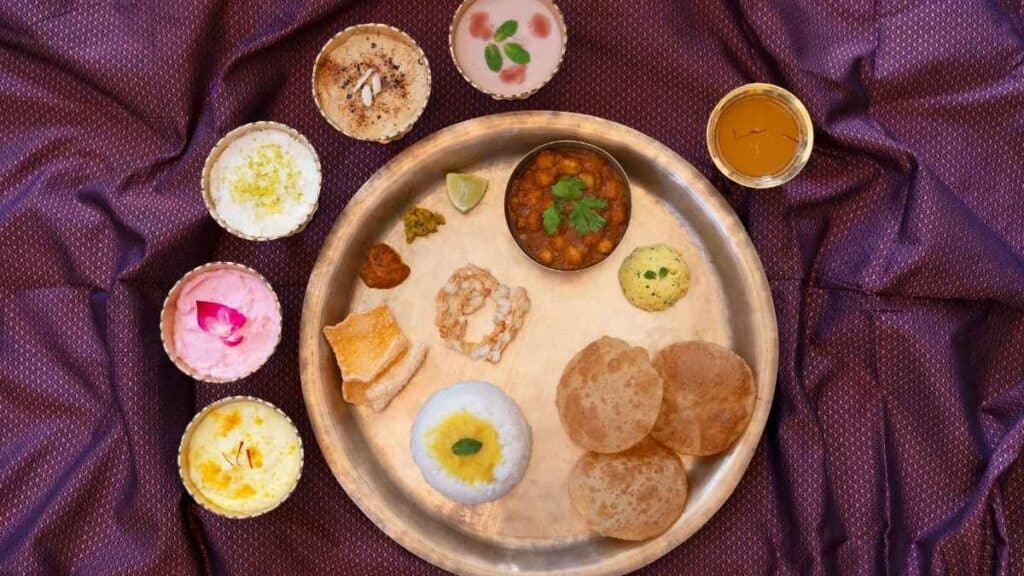
Food is central to Gudi Padwa, and the festival has one of the richest culinary traditions in the Maharashtrian calendar. The first food of the day carries deep philosophical meaning; the rest of the festive meal is pure celebration.
The Ritual First Food — Neem-Jaggery Prasad
The ritual first food of Gudi Padwa is the Neem-Jaggery Prasad — fresh neem leaves mixed with raw jaggery, tamarind, ajwain, and dhane seeds, intentionally bitter, sweet, sour, and astringent all at once. Consumed before anything else on the morning of Gudi Padwa, it is a reminder that life holds all experiences and we enter the new year with acceptance and equanimity.
Common Gudi Padwa Delicacies
- Puran Poli — Sweet flatbread stuffed with a rich filling of chana dal, jaggery, cardamom, and nutmeg, served warm with ghee — the undisputed centrepiece of the festive meal.
- Shrikhand and Amrakhand — Thick sweetened strained yoghurt flavoured with saffron and cardamom, or fresh mango pulp, served chilled.
- Sakhar Bhat — Saffron-infused sweet rice with nuts and raisins, often offered as prasad.
- Ukadiche Modak — Steamed rice flour dumplings stuffed with coconut and jaggery.
- Kothimbir Vadi — Savoury steamed and fried coriander gram flour cakes.
- Katachi Amti — Spiced lentil soup made from the cooking water of the Puran Poli dal, a beloved Maharashtrian tradition of wasting nothing.
These dishes are prepared at home and shared freely with neighbours, friends, and guests — the festival’s spirit of hospitality being as important as its rituals.


Gudi Padwa: Music, Art, and Cultural Expression
Music, art, and performance are inseparable from Gudi Padwa, bringing energy and beauty to the festival.
Traditional Music and Shobha Yatra
The streets of Maharashtra come alive on Gudi Padwa morning with the sound of the dhol, tashe, and nafiri — the traditional percussion ensemble that accompanies the Shobha Yatra processions. Folk songs celebrating spring, songs in praise of King Shalivahan, and devotional bhajans dedicated to Vitthala fill the air throughout the day.
Lavani
Lavani — Maharashtra’s energetic, rhythmic folk dance tradition — reaches its annual peak during Gudi Padwa festivities. Performances featuring women in nine-yard sarees moving to the beat of the dholki are a highlight of community celebrations both in Maharashtra and in diaspora events worldwide.
Rangoli
Rangoli drawn at the entrance of homes — intricate floor designs made with rice flour or coloured powders — is one of the festival’s most beautiful visual traditions. Rangoli competitions are held across cities, schools, and housing societies, celebrating this art form as a living part of the Gudi Padwa experience.
Kirtan
Kirtan performances in temples and public spaces bring the festival’s mythological stories — of Brahma’s creation, Rama’s victory, and Shalivahan’s triumph — to life through devotional music and storytelling.
Gudi Padwa’s Modern Relevance and Cultural Continuity
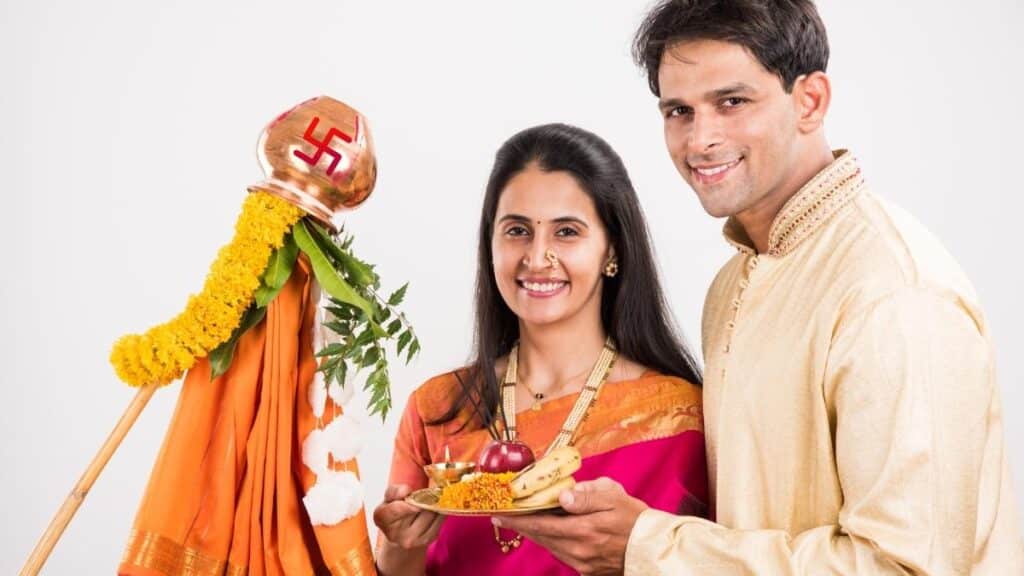
In today’s fast-changing world, Gudi Padwa continues to hold deep relevance as a festival that celebrates identity, community, and the enduring human need to mark time with meaning.
For the Maharashtrian diaspora — millions of people who have built lives across North America, Europe, the Middle East, and Southeast Asia — Gudi Padwa is more than a festival. It is a living connection to language, history, and culture. The Gudi raised in a Toronto apartment or a Melbourne home carries the same intention as the one raised on a Pune street: to welcome the new year with gratitude, to taste life’s full range of flavours with acceptance, and to celebrate the victory of hope over uncertainty.
Gudi Padwa’s enduring relevance lies in its ability to adapt while staying true to its essence — celebrating new beginnings, community pride, and the timeless belief that every year begins with the promise of victory and renewal.
Gudi Padwyachya Shubhechha! Wishing you a joyous and abundant Marathi New Year 2026.