


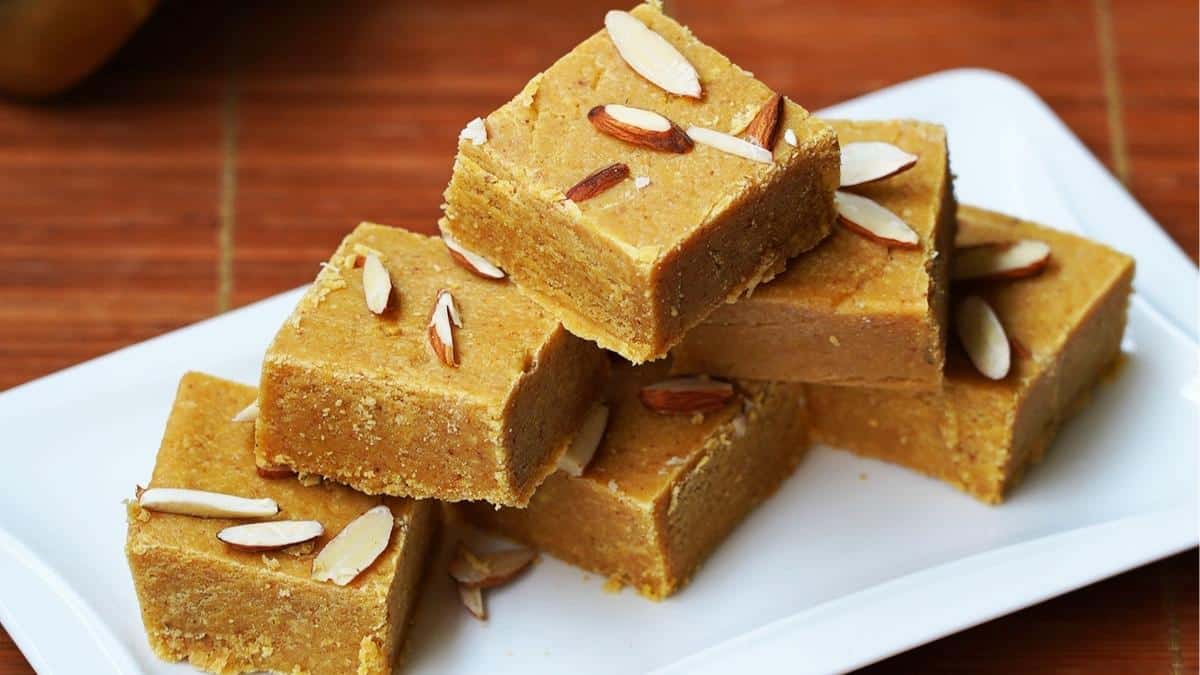
There are certain sweets that don’t just end a meal — they complete a prayer. Sweets where the act of making them is itself a form of devotion, where the ghee-soaked aroma rising from the kadai feels less like cooking and more like offering. Mohanthal, the grainy besan fudge from Gujarat and Rajasthan, is exactly that kind of mithai.
Mohanthal is made for Ram Navami with particular intention. The festival — celebrating the birth of Lord Ram on the ninth day of Chaitra Navratri — calls for a prasad that is pure, rich, and made with care. Mohanthal fits every requirement. It is sattvic, deeply auspicious, made entirely from ingredients considered sacred in Hindu tradition: besan from chickpeas, ghee clarified with patience, sugar syrup pulled to exactly the right consistency, saffron that colours everything it touches a warm, devotional gold. In Gujarati and Rajasthani homes, mohanthal on Ram Navami is not optional — it is the sweet that sits on the puja thali before anything else does.
Mohanthal is a ghee-rich, grainy besan fudge from Gujarat — one of the most traditional prasad sweets for Ram Navami. It’s made by rubbing ghee and milk into coarse besan by hand (dhrabo), slow-roasting it until caramel-gold, then combining with a saffron-cardamom sugar syrup pulled to exactly one-string consistency. Add khoya to the syrup for halwai-style richness. Cool the besan completely before combining — that single step is what most people get wrong. Set for 4–5 hours, garnish with pistachios and silver vark, cut into 16 pieces. Keeps for a month in the fridge, travels well as prasad, and tastes like a kitchen that knew what it was doing.
In this Article
What Makes Mohanthal the Right Sweet for Ram Navami Prasad?
Mohanthal looks deceptively simple from a distance — besan, ghee, sugar — and reveals its true depth only in the making. Many people who encounter it at a festival assume it’s a fancier version of besan burfi. It isn’t. The difference is fundamental, and it lives in a single Gujarati word: dhrabo.
Dhrabo is the foundational technique of mohanthal — rubbing a small amount of ghee and milk into raw besan using your palms for a full two minutes, until the flour turns moist, crumbly, and almost sandy. This step coats every individual particle of besan with fat before it ever touches the stove, and that is what creates mohanthal’s signature texture: grainy, slightly loose, melt-in-the-mouth in a way that smooth besan burfi simply cannot replicate.
For Ram Navami specifically, mohanthal’s sattvic ingredient profile makes it the ideal prasad. It contains no onion, no garlic, nothing considered rajasic or tamasic — just pure, clarified ghee, chickpea flour, sugar, saffron, and cardamom. The saffron turns the entire sweet a warm, devotional gold that feels appropriate on a puja thali. The cardamom lingers. The ghee pools in tiny amber pockets. It is the kind of sweet that people fold their hands before eating.
Recipe Overview
| Detail | Information |
|---|---|
| Prep Time | 20 minutes |
| Dhrabo Resting Time | 20 minutes (passive) |
| Cook Time | 30 minutes |
| Setting Time | 4–5 hours minimum |
| Total Time | Approx. 5 hours |
| Yield | 16 pieces |
| Servings | 8–10 people |
| Cuisine | Gujarati / Rajasthani |
| Course | Festival Sweet, Prasad, Mithai |
| Diet | Vegetarian, Gluten-Free, Sattvic |
| Difficulty Level | Medium |
| Calories Per Piece | ~247 kcal |
| Festival | Ram Navami |
Why Mohanthal Belongs on the Ram Navami Thali
Ram Navami — the ninth and final day of Chaitra Navratri, marking the birth of Lord Ram at the auspicious mid-morning hour of Abhijit Muhurta. In homes observing the festival, the puja thali is prepared carefully: flowers, fruit, panchamrit, and prasad that has been made with a clean kitchen and clean hands. Mohanthal is among the most traditional prasad sweets offered on this day, particularly in Gujarat, Rajasthan, and among diaspora communities that carry these regional practices into new geographies.
The sweet earns its place on the Ram Navami thali for several reasons that go beyond taste. It is entirely sattvic — made without ingredients that are avoided during vrat or puja. The ghee used to roast the besan is considered purifying in Hindu tradition, and offering ghee-based sweets as prasad carries specific religious significance. The saffron, beyond colouring the sweet gold, is one of the most auspicious flavourings in Indian ritual cooking. Even the act of making mohanthal — the continuous stirring, the patience required, the attention demanded — carries a meditative quality that feels appropriate on a day of devotion.
In Gujarati households, mohanthal for Ram Navami is often made in large batches — enough for the puja, enough for the family lunch, enough for neighbours and the extended family who will visit through the day. The tin dabba of mohanthal that gets passed around after aarti is one of those quiet festival rituals that doesn’t need explaining. Everyone knows what it means. Everyone reaches for a piece.
For diaspora families observing Ram Navami abroad, mohanthal has become one of the most searched Indian sweets during the Chaitra Navratri period — because few other sweets carry the same combination of ritual appropriateness, distinctive flavour, and emotional resonance with home.
The Two Critical Techniques: Dhrabo and One-String Syrup
Before the step-by-step, two techniques determine whether your mohanthal has that authentic grainy halwai texture or becomes something disappointing — too hard, too smooth, or crumbling apart.
1. The Dhrabo — properly crumbled besan base
This is the technique that sets mohanthal apart from every other besan sweet, and it cannot be skipped or rushed. Raw besan must be rubbed — physically, by hand, between your palms — with a small amount of ghee and milk until it becomes moist and crumbly, resembling coarse wet sand or rough breadcrumbs. This takes a full two minutes of active rubbing, not just stirring. The mixture then rests for 20 minutes so the fat fully coats each particle. It is then sifted to remove any lumps, with any unsievable pieces pulsed in a spice grinder. Only after this entire process — crumble, rest, sift — does the besan go into the kadai.
Without dhrabo, you get besan burfi. With dhrabo, you get mohanthal.
2. One-string sugar syrup — exactly right, not overdone
The sugar syrup must reach precise one-string consistency — the point at which a drop placed between thumb and forefinger forms a single, unbroken thread when the fingers are slowly pulled apart. In temperature terms, this is 112°C (234°F). Under-done syrup produces mohanthal that won’t set. Over-done syrup produces mohanthal that sets rock-hard. The window is narrow, which is why a kitchen thermometer is strongly recommended for anyone making this for the first time.
Ingredients List
Besan Base (Dhrabo)
| Ingredient | Quantity | Notes |
|---|---|---|
| Coarse besan (ladu besan) | 1¾ cup / 250g | Coarse variety gives the grainy texture; available at Indian grocery stores |
| Ghee, melted | 1½ tbsp | For the dhrabo rubbing step only |
| Whole milk | 1½ tbsp | For the dhrabo rubbing step only |
For Roasting
| Ingredient | Quantity | Notes |
|---|---|---|
| Ghee, melted | ½ cup + 2 tbsp (150ml) | Use good quality desi ghee |
| Whole milk | ½ cup (120ml) | Added in two batches during roasting |
| Khoya / mawa | ½ cup | Optional but strongly recommended for halwai-style richness |
Sugar Syrup
| Ingredient | Quantity | Notes |
|---|---|---|
| Granulated white sugar | 1 cup / 200g | |
| Water | ¾ cup / 180ml | |
| Saffron strands | Generous pinch | Soaked in 2 tbsp warm water for 5 minutes before using |
| Cardamom powder | 1 tsp |
For Garnish
| Ingredient | Quantity | Notes |
|---|---|---|
| Chopped pistachios and almonds | As needed | Press gently into surface before setting |
| Edible silver vark | Optional | Applied after cutting, for presentation |
| Edible gold leaf | Optional | For a particularly festive and auspicious finish |
Step-by-Step Instructions: Making Perfect Mohanthal
Step 1: Make the Dhrabo — Danedar Besan Base (20 Minutes)
In a large mixing bowl, combine coarse besan with 1½ tbsp melted ghee and 1½ tbsp whole milk. Using both hands, begin rubbing the mixture firmly between your palms — not just mixing, but actively crumbling it — for a full two minutes. The mixture should transform from dry flour into something that looks like coarse, moist breadcrumbs. Every grain of besan should feel slightly coated.
Pass the entire mixture through a medium-coarse sieve. If there are pieces too large to pass through, transfer them to a spice grinder, pulse briefly until powdered, and add back to the main bowl. Cover the bowl with a plate and let it rest for 20 minutes. This passive resting time allows the fat and milk to fully integrate with the besan, which is what produces the characteristic grainy texture in the finished sweet.
Time: 2 minutes active rubbing + 20 minutes passive rest
Step 2: Slow Roast the Besan (17 Minutes Active)
Heat ½ cup + 2 tbsp ghee in a heavy-bottomed kadai or pan on medium heat. Add the rested dhrabo besan and begin stirring immediately with a spatula. Keep stirring — continuously, without stopping. After 6–7 minutes, the besan will visibly loosen, becoming lighter and more airy, almost as though it has puffed slightly.
Continue roasting and stirring for another 5–7 minutes until the besan deepens to a rich caramel-gold colour and smells distinctly nutty and toasty. This is the aroma that fills the kitchen on Ram Navami morning — the smell that announces the prasad is being made.
Reduce the heat to low. Add ¼ cup of milk in a slow stream, stirring continuously — the colour and consistency will change immediately. Add the remaining ¼ cup milk and stir until fully absorbed. Turn off the heat, but do not stop stirring. The residual heat of the stove and pan will continue cooking the besan for another 5 minutes — keep stirring throughout. Remove the pan from the stove entirely and allow the besan to cool completely to room temperature before moving to the next step.
Time: 17 minutes active stirring + cooling time
Step 3: Make the Saffron Sugar Syrup (10 Minutes)
Combine 1 cup sugar and ¾ cup water in a separate pan. Bring to a boil over medium heat, stirring until the sugar dissolves. Once boiling, add the prepared saffron water — saffron strands soaked in 2 tbsp warm water for 5 minutes, turning a deep, auspicious orange — and 1 tsp cardamom powder.
For halwai-style mohanthal, add ½ cup khoya directly into the hot sugar syrup at this stage and stir until completely dissolved. The syrup will turn silky and rich. Reduce to low heat and simmer for 5–6 minutes, testing frequently for one-string consistency. A thermometer should read 112°C (234°F) when ready.
Time: 10 minutes
Step 4: Combine and Set (5 Minutes Active + 4–5 Hours Setting)
Verify that the roasted besan has cooled completely to room temperature — this step is non-negotiable. Pour the hot sugar syrup over the cooled besan and place the pan back on low-medium heat. Stir thoroughly for just 1–2 minutes, until the mixture thickens slightly, turns glossy, and begins to pull away from the sides of the pan. Stop at this point. Every additional minute of cooking risks a hard final result.
Transfer the mixture immediately into an 8×8 inch pan lined with parchment paper. Press down firmly and evenly with a spatula. Scatter chopped pistachios and almonds generously over the surface and press gently so they adhere. Add edible silver vark or gold leaf for a festive, auspicious finish. Allow to set at room temperature for 4–5 hours, or refrigerate overnight. Once fully set, cut into 16 even pieces.
Time: 5 minutes active + 4–5 hours setting
Step 5: Offer and Serve
For Ram Navami, mohanthal is first placed on the puja thali as prasad before being distributed. Remove from the fridge 20–30 minutes before the puja so the ghee softens and the flavour fully opens. Arrange pieces on a silver or brass plate lined with a clean cloth or banana leaf for a traditional presentation. After aarti and offering, distribute as prasad to family and guests.
Expert Tips for Perfect Mohanthal
- Use coarse (ladu) besan. Fine besan produces a softer, smoother result. Coarse besan creates the grainy, fudgy bite that defines authentic mohanthal. If only fine besan is available, the dhrabo technique becomes even more important to compensate.
- Never stop stirring during roasting. Besan burns at the bottom extremely quickly. A heavy-bottomed pan and continuous stirring on medium heat throughout are non-negotiable. If you walk away, even briefly, it will burn.
- Sift the dhrabo properly. Unsifted lumps create uneven texture in the final sweet. If pieces won’t pass through the sifter, pulse briefly in a spice grinder. The smoother the dhrabo mixture, the more uniform the final texture.
- Cool the besan completely before adding syrup. If you pour sugar syrup over warm besan, the sweet will crumble and refuse to set. Room temperature means genuinely cooled — not slightly warm, not just off the stove. This is the step most first-timers skip in impatience, and it shows in the result.
- Invest in a kitchen thermometer. One-string consistency is difficult to gauge consistently by the finger test alone, especially at high altitude or with different pan thicknesses. A thermometer targeting 112°C (234°F) removes all guesswork and is the single most useful purchase for anyone who makes Indian sweets regularly.
- Add khoya to the syrup, not to the besan. When making halwai-style mohanthal, khoya should be dissolved into the hot sugar syrup before combining with the besan. Adding it directly to the besan during roasting changes the texture unpredictably.
- Don’t overcook after combining. The final stirring step — once syrup meets besan — should last no more than 1–2 minutes. The moment the mixture becomes thick, slightly non-sticky, and begins leaving the pan sides, it is done.
Regional Variations and Adaptations
Gujarati style emphasizes the dhrabo technique and characteristic grainy texture. Khoya is commonly included, and the sweet is flavoured with both saffron and cardamom, garnished with silver vark. This is the version most closely associated with Ram Navami prasad in Gujarati communities.
Rajasthani style sometimes incorporates mace (javitri) as an additional flavouring alongside cardamom, giving the sweet a slightly more complex, aromatic quality. The texture can vary slightly by region, with some preparations being softer and richer.
Diaspora adaptations exist out of practical necessity. In countries where ladu besan is unavailable, regular besan works with extra attention to the dhrabo. Khoya can be approximated using full-fat ricotta or slow-reduced whole milk, though the flavour differs. Some diaspora versions add a small amount of rose water alongside the saffron, which pairs well with the Ram Navami festive mood.
Vrat-friendly version: For households observing a strict fast during Chaitra Navratri, the standard recipe is already appropriate as mohanthal contains no grains — besan is made from chickpeas, not wheat. Verify with your family tradition, as vrat rules vary by region and household.
Storage and Prasad Distribution Guide
Stored in an airtight container in the refrigerator, mohanthal keeps well for up to one month. At room temperature in an airtight container, it stays fresh for 2–3 weeks. The ghee content acts as a natural preservative — which is part of why ghee-based sweets have historically been used as prasad, since they can be made ahead and distributed over multiple days of celebration.
For prasad distribution at larger gatherings, cut pieces are traditionally wrapped individually in small squares of foil or placed in paper cups — both practical and easy to distribute after aarti. For gifting to neighbours and family on Ram Navami, stack pieces in a small tin or box with parchment between layers.
For diaspora gifting: mohanthal travels well domestically when sealed. For sending to family internationally, the month-long refrigerated shelf life gives comfortable margin for standard shipping timelines.
Why This Sweet Still Matters
In the landscape of Ram Navami prasad, mohanthal occupies a particular kind of devotional territory. It is not the fastest sweet to make, nor the simplest. What it is, reliably, is the one that requires your full presence — and that quality of attention, given on a day of prayer, carries its own meaning.
The dhrabo cannot be rushed. The roasting cannot be left unattended. The syrup cannot be guessed at. Every step of mohanthal demands that you stay with it, and on Ram Navami — a day when the intention is to be present, to offer something made with care, to sit with the festival rather than just observe it — that demand becomes appropriate. The making becomes part of the offering.
For diaspora families recreating Ram Navami abroad, there is something quietly significant about standing at a stove in April, hand-rubbing besan and ghee between your palms, reproducing a technique passed down from someone who learned it from their mother, who learned it from hers. The puja may be smaller. The gathering may be just your household. The aarti may be played from a phone rather than sung by a room full of people. But the mohanthal on the thali — golden, saffron-scented, made with patience — says what words don’t always manage to.
Festivals are how cultures remember themselves. Mohanthal for Ram Navami is how a kitchen becomes a temple, even just for a morning.
Shri Ram Navami ki hardik shubhkamnayein. Jai Shri Ram.
