


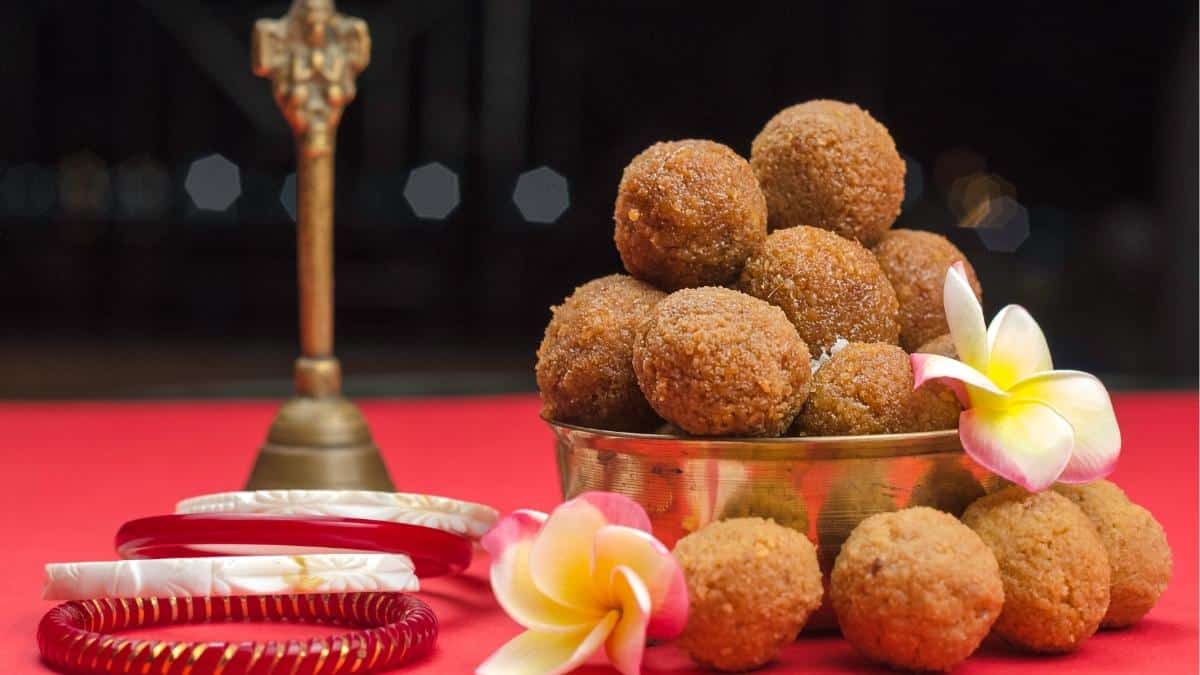
There are certain sweets that don’t just taste good — they feel right. Sweets that carry devotion in their making, that fill the kitchen with a warmth that has nothing to do with the stove, and that land on a puja thali the way they always have, generation after generation. Narkel Naru is exactly that kind of sweet.
For Ram Navami, the day Lord Ram was born, the puja thali must be sattvic — clean, simple, made with intention. And Narkel Naru fits that brief perfectly. Fresh coconut, jaggery, a whisper of cardamom. No onion, no garlic, no fuss. Just an honest sweet made with hands and offered with a full heart.
Narkel Naru is a traditional Bengali coconut ladoo made with jaggery — sattvic, simple, and perfectly suited as Ram Navami prasad. Fresh coconut is dry-roasted to remove moisture, cooked with melted jaggery for 6–7 minutes, flavoured with cardamom, cooled, and shaped by hand into round ladoos. Critical technique: don’t overcook — use the ball test to check doneness and switch off immediately. Ready in 15 minutes, stores for up to a week.
What Makes Narkel Naru the Ideal Ram Navami Prasad?
Narkel Naru exists in many forms across Indian sweet traditions, but the Bengali jaggery version has qualities that make it particularly suited to Ram Navami prasad:
- Fully sattvic ingredients, no compromise. Coconut, jaggery, and cardamom are all sattvic by nature — pure, grounding, and appropriate for religious offering. There is nothing in this recipe that conflicts with the spirit of the day.
- Jaggery over sugar — earthier, more traditional. While the sugar version (Chinir Narkel Naru or Sada Naru) exists and has its place, the jaggery-based Gurer Narkel Naru carries a deeper, more complex sweetness — caramel-edged, subtly mineral — that feels more connected to the land and to older ways of cooking.
- Ready in fifteen minutes, no special equipment. A kadai, a spatula, and your hands are all you need. For festivals when the kitchen is already managing multiple dishes, a prasad that comes together this quickly — without any fuss — is genuinely valuable.
- Scales effortlessly for large gatherings. Whether you’re making prasad for your immediate family or for an entire mandal, this recipe doubles, triples, and quadruples without changing technique.
- Beautiful without being decorated. The warm brown ladoos, shaped by hand, look exactly like something made in a home kitchen with love. That honesty is part of what makes them feel sacred.
Recipe Overview
| Detail | Information |
|---|---|
| Prep Time | 5 minutes |
| Cook Time | 10 minutes |
| Total Time | 15 minutes |
| Yield | 10 ladoos |
| Servings | 4–5 people |
| Cuisine | Bengali, Indian |
| Course | Prasad, Sweets, Festival Dessert |
| Diet | Vegetarian, Sattvic, Vegan-adaptable |
| Difficulty Level | Easy |
| Calories per Ladoo | ~146 kcal |
| Festival | Ram Navami (April 6, 2026) |
Why Narkel Naru Belongs on Every Ram Navami Thali
Ram Navami, the ninth day of Chaitra Navratri, marks the birth of Lord Ram — and the puja observance calls for bhog and prasad that reflect purity and simplicity. Narkel Naru earns its place on the Ram Navami thali for several specific reasons.
Sattvic by composition. Ram Navami fasting and puja protocols require food free of tamasic ingredients. Narkel Naru uses nothing that conflicts with this — no refined sugar (if you use jaggery), no processed additives, just whole ingredients in their most straightforward form.
Appropriate naivedyam for Vishnu avatars. Lord Ram, as an avatar of Vishnu, is traditionally offered sweets made with coconut and jaggery in Bengali and eastern Indian puja traditions. Narkel Naru sits squarely within this tradition.
Prepared with hands, not machinery. The act of shaping each ladoo by hand — pressing the warm mixture between your palms, rolling it into a smooth ball — is itself a meditative, devotional act. In many homes, this shaping is done after a bath, with clean hands, in a state of puja-readiness.
Post-aarti timing, mid-morning or evening. Ram Navami puja typically concludes with bhog distribution in the mid-morning after the birth celebration rituals (Janmotsav), or in the evening during sandhya aarti. Narkel Naru, which keeps well at room temperature for several hours, suits both timings.
Community distribution — prasad for everyone. Because this recipe scales easily and stores well in an airtight container, it is well-suited to prasad distribution at temples, community celebrations, and neighbourhood gatherings where the same sweetness needs to reach many hands.
The Two Critical Techniques: Dry Roasting and the Doneness Test
Before the step-by-step, two techniques determine whether your Narkel Naru is perfectly soft or regrettably chewy. Get these right and the rest follows easily.
1. Dry-Roasting the Coconut Before Adding Jaggery
Fresh coconut carries significant moisture. If you skip roasting and add jaggery directly to raw coconut, the released liquid prevents the mixture from coming together — you’ll end up with a wet, sticky mass that won’t hold shape.
Roast the coconut on low flame for 4–5 minutes, stirring constantly, until it looks slightly drier but not browned at all. You’re not toasting it for colour or flavour — you’re simply removing excess moisture so the mixture will bind later. The coconut should remain white to off-white throughout.
2. The Ball Test — Your Only Reliable Doneness Check
The mixture is ready when it can be shaped — not before, not after. Overcooking (even by 2–3 minutes) produces ladoos that are dense, chewy, and hard once cooled, because the jaggery continues to caramelise beyond the soft-ball stage.
To test: take a small spoonful of the hot mixture, let it cool on the counter for 60 seconds, then try to roll it between your fingers into a small ball. If it holds shape cleanly, switch off the flame immediately and proceed. If it crumbles or feels too soft, cook for another minute and test again.
Ingredients
Base Components
| Ingredient | Quantity | Notes |
|---|---|---|
| Fresh grated coconut | 2 cups | Freshly grated preferred; desiccated coconut works but reduces flavour |
| Organic jaggery (powder or grated) | 1 cup | Dark jaggery gives richer colour and deeper flavour |
| Green cardamom powder | ½ tsp | Optional but recommended for festive flavour |
| Ghee or coconut oil | 1–2 tsp | For greasing palms before shaping |
Optional Add-ins
| Ingredient | Quantity | Notes |
|---|---|---|
| Nolen gur (date palm jaggery) | Replace regular jaggery | Winter specialty; use if available for superior flavour |
| Chopped cashews or pistachios | 2 tbsp | Fold in after switching off heat for added texture |
Step-by-Step Instructions: Making Perfect Narkel Naru
Step 1: Dry-Roast the Coconut (5 Minutes)
Heat a heavy kadai or thick-bottomed pan on low flame — not medium, not high. Add the 2 cups of fresh grated coconut directly to the dry pan (no oil or ghee at this stage).
Stir continuously for 4–5 minutes. The coconut will release some steam as the moisture evaporates. Keep the flame low and the stirring constant — the goal is a slightly drier coconut that remains white throughout. The moment you see any yellowing, reduce the flame further.
Time: 5 minutes
Step 2: Add Jaggery and Cook the Mixture (7 Minutes)
Add 1 cup of jaggery — powder, grated block, or crumbled — directly into the pan with the roasted coconut. If using block jaggery that is not organic, dissolve it first in 2–3 tablespoons of water, strain the syrup through a fine sieve to remove impurities, and use the clean syrup instead.
Mix the jaggery into the coconut thoroughly so there are no pockets of undissolved sweetener. Cook on low to medium-low flame, stirring without stopping, for approximately 6–7 minutes. The jaggery will melt, the mixture will begin to look glossy, and gradually thicken and pull away slightly from the sides of the pan.
Time: 7 minutes
Step 3: Test for Doneness and Add Cardamom
At the 6-minute mark, begin testing. Take a small amount on a spoon, set it aside for 60 seconds to cool slightly, and try to form a small ball. If it holds, switch off the flame immediately.
Add the cardamom powder and mix well. If adding nuts, fold them in now. Let the mixture rest in the pan on the countertop — not on a hot burner — and allow it to cool completely to room temperature before shaping.
Time: 5 minutes cooling test + 15–20 minutes full cooling
Step 4: Shape the Ladoos (10 Minutes)
Rub a little ghee or coconut oil between your palms. Take a small to medium portion of the cooled mixture — roughly the size of a large marble — and press and roll it between your palms into a smooth, round ball.
The ladoo should feel firm but not hard, smooth on the outside, and hold its shape without cracking. If the mixture feels too soft still, let it cool for another 5 minutes. If it feels dry and crumbly, the mixture was slightly overcooked — press firmly and it will still come together.
Time: 10 minutes for a batch of 10
Step 5: Offer as Prasad or Serve
Arrange the Narkel Naru on a clean puja thali or silver plate. Offer to Lord Ram during aarti with a small tulsi leaf beside each ladoo if desired — tulsi is sacred to Vishnu and his avatars. After the offering, distribute as prasad to all present.
Store leftovers in an airtight container at room temperature for 2–3 days, or refrigerate for up to a week.
Expert Tips for Perfect Narkel Naru
- Always use organic jaggery when possible — it skips the straining step and gives a cleaner, deeper flavour without impurities. Non-organic block jaggery sometimes contains grit or debris that must be filtered out.
- The cardamom goes in off heat, not during cooking. Adding it too early can make the flavour turn sharp; adding it at the end preserves the floral, fragrant quality.
- Colour follows jaggery. Light jaggery gives pale tan ladoos; dark, aged jaggery gives deep brown ones. Both are correct — the shade is a reflection of your ingredient, not of your technique.
- If you can source nolen gur (date palm jaggery), even in its solid patali form, use it. The flavour difference is significant — it has a caramel-meets-wood complexity that regular sugarcane jaggery simply cannot replicate.
- Let the mixture cool fully before shaping. Rushing this step means the warmth in the mixture will prevent proper binding and your ladoos will flatten as they cool further.
Regional Variations and Adaptations
Nolen Gur Narkel Naru (Winter Classic): The most prized version, made with date palm jaggery available in the winter months. The liquid form (jhola gur) or solid patali form both work — jhola gur requires slightly longer cooking to reduce the extra moisture.
Chinir Narkel Naru (Sugar Version): Made with white sugar instead of jaggery. Lighter in colour, milder in flavour, and often coated in desiccated coconut before serving. Common at mithai shops; less traditional at home.
Khoya-Enriched Version: Some mithaiwala recipes add a small amount of khoya (mawa) for creaminess. This version has a richer mouthfeel but is no longer strictly sattvic and is less appropriate as prasad.
With Dry Fruits: Chopped cashews, raisins, or slivered almonds folded into the mixture before shaping. Popular for festive batches meant for distribution.
Vegan Adaptation: The recipe is naturally vegan if you use coconut oil instead of ghee for greasing your palms. Everything else is plant-based.
Diaspora Adaptation: Many Bengalis outside India use desiccated coconut when fresh coconut is unavailable. Reduce cooking time slightly as desiccated coconut has less moisture to begin with, and the mixture will thicken faster.
Make-Ahead Strategy for Ram Navami
Two Days Before
Grate fresh coconut and store in the refrigerator in an airtight container. Grate or crumble the jaggery and keep separately.
Day Before
Make the full batch of Narkel Naru. Cool completely, store in an airtight container at room temperature. They will be in perfect condition the next day — some cooks argue they taste better on day two as the flavours settle.
Festival Morning
Arrange on the puja thali an hour before aarti. No reheating needed. Add a fresh tulsi leaf to the plate just before the offering.
Serving Suggestions and Presentation
- Puja thali placement: Arrange 3–5 Narkel Naru on a small silver or brass katori on the puja thali, alongside Panakam (jaggery-pepper drink) and other Ram Navami bhog items like fruits and panchamrit.
- Temple distribution: For community puja, pack individual ladoos in small paper cups or donas for clean, hygienic prasad distribution. A batch of 30–40 ladoos can be made in under an hour.
- Festive gifting: Pack in small boxes or muslin pouches for gifting to neighbours and extended family on Ram Navami — a practice that carries the warmth of the festival beyond your own home.
- Paired with Panakam: In South Indian and pan-regional Ram Navami traditions, Narkel Naru served alongside Panakam — a cooling drink of jaggery, water, black pepper, and dry ginger — makes for a complete, traditional bhog pairing.
Why This Prasad Still Matters
In the full landscape of Indian festival sweets, Narkel Naru occupies a particular and irreplaceable position — it is not elaborate, not decorated, not designed for display. It is a sweet that exists entirely in the act of making it and the act of offering it.
What makes Narkel Naru significant for Ram Navami is precisely its humility. Lord Ram, in the arc of his own story, is the avatar who chose simplicity over spectacle, who accepted forest berries from Shabari with the same grace he might have received royal feasts. Offering him a ladoo made of coconut and jaggery, shaped by hand with care, feels appropriate in a way that more ornate mithai sometimes doesn’t.
For Bengalis in the diaspora especially, making Narkel Naru on Ram Navami is a form of cultural continuity — keeping a kitchen practice alive across geographies, passing the muscle memory of how a ladoo should feel between your palms to children who have never seen the inside of a Bengali sweetshop. That’s not a small thing. That’s how culture actually survives.
Jai Shri Ram.
