


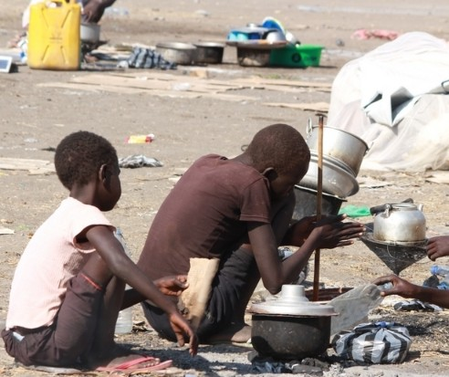
Nearly 19.5 million individuals in Sudan are experiencing severe levels of acute food insecurity, as reported by the Food and Agriculture Organization (FAO), the World Food Programme (WFP), and the United Nations Children’s Fund (UNICEF). The situation is particularly dire in 14 areas within Greater Darfur and Greater Kordofan, with conditions expected to worsen during the lean season from June to September, according to Farhan Haq, the UN secretary-general’s deputy spokesperson.
Despite ongoing humanitarian efforts, the assistance provided falls significantly short of the immense needs on the ground. Between February and May, humanitarian partners aimed to assist 4.8 million people monthly, yet only around 3.13 million individuals received aid in February, Haq revealed. FAO, WFP, and UNICEF are calling for an immediate halt to hostilities and urging the international community to increase funding urgently for food, emergency food production, nutrition, health, water and sanitation services, and livelihood restoration initiatives.
In a recent update on May 13, humanitarian aid was reported to be distributed in conflict-affected southwestern Sudan, with a specific focus on allocating $12 million for famine relief in neighboring South Sudan. The UN Office for the Coordination of Humanitarian Affairs (OCHA) emphasized the ongoing response to humanitarian needs throughout Sudan, with a particular focus on providing life-saving assistance to displaced persons, refugees, and host communities in the Kordofan region.
Within the Kordofan region, aid organizations are delivering critical support, including water and sanitation aid to approximately 85,000 individuals in Sheikan and Ar Rahad localities in North Kordofan state. Essential items such as blankets, mosquito nets, and household supplies have been distributed to 2,000 displaced families in Sheikan, while cash aid reached 200 families at the Taggat displacement site in April. In South Kordofan state, nearly 88,000 individuals, including South Sudanese refugees, displaced persons, and host communities, have received vital water and sanitation assistance. However, ongoing conflict poses a significant threat to the safety of civilians.
