


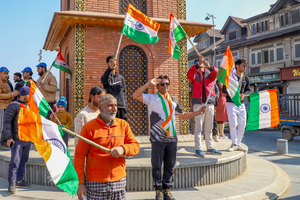
New Delhi, Aug 4 (IANS) There are few dates in the subcontinent’s calendar that two nations mark in such opposite spirit.
On August 5, India observes the anniversary of the constitutional changes of 2019 that ended the special status of Jammu and Kashmir and integrated it fully into the Union of India.
On the very same day, across the border, Pakistan observes what it calls ‘Youm-e-Istehsal’, a Day of Exploitation, framing that integration as an act of subjugation against the people of Kashmir.
Two neighbours, one date, two entirely irreconcilable stories. The question worth asking, seven years on, is a simple one. Whose story does the ground actually support?
The answer does not lie in the language of either government. It lies in what can be measured, and in what the people on each side of the Line of Control (LoC) are themselves saying and doing.
On one side, the evidence points to investment, connectivity and a return to the ballot. On the other, the evidence points to protest, crackdown and a population in open agitation against the very state that claims to be its protector. The contrast is stark enough that it is worth setting out plainly.
What seven years have built
Consider first the record in Jammu and Kashmir, much of which is a matter of official documentation. According to figures cited by the Government of India, investment proposals worth tens of thousands of crores have flowed into the Union Territory since 2019, in a place where attracting private capital had long been constrained. The most visible symbol of the change is the Railway. The Udhampur-Srinagar-Baramulla line, declared a national project, now connects the Kashmir Valley to the rest of the country for the first time in history, carried across the Chenab by the highest railway bridge in the world, with a Vande Bharat service flagged off in June 2025. The details of these projects are set out in the government’s own public records.
The transformation extends beyond rail. An All India Institute of Medical Sciences has come up in Jammu, along with a new campus of the Indian Institute of Management and the Indian Institute of Technology, institutions that anchor healthcare and higher education in a region that once had to send its young and its sick elsewhere.
Tourism, the traditional lifeblood of the Valley, reached record levels, with government figures pointing to more than two crore visitors in a single recent year. None of this is to claim that every problem has been solved. The Pahalgam attack of April 2025 was a grievous reminder that the security challenge has not vanished, and it interrupted the tourist season sharply. Honesty requires acknowledging that the work of normalisation remains unfinished. But the direction of travel is not seriously in doubt.
The deeper change may be the quietest one. The return of grassroots democracy, through panchayat and District Development Council elections and then the Assembly polls of 2024, has placed decision-making in the hands of elected local representatives, including a striking number of young people and women entering public life for the first time. Whatever one’s view of the constitutional changes of 2019, the restoration of the ballot at the village level is not the mark of a territory under subjugation.
Where the real exploitation lies
Now turn the map around and look at the territory Pakistan actually administers. Here the word ‘Istehsal’ or exploitation, acquires a meaning that Islamabad did not intend. For the picture that has emerged from Pakistan-occupied Jammu and Kashmir (PoJK) over the past three years is not one of contented governance. It is one of sustained popular revolt against economic hardship and political powerlessness, met by the State with force.
The grievances are not those of an outside agitator. They are the everyday complaints of ordinary residents, voiced through the territory’s own civil society coalitions. Chief among them is a bitter irony about electricity. PoJK generates substantial hydroelectric power from its rivers, yet its people, by the account of their own traders’ and citizens’ committees, pay among the highest rates in the region while the power itself is fed to the national grid. Alongside this run demands for subsidised wheat flour, relief from inflation, and an end to the privileges enjoyed by officials. When a population takes to the streets over the cost of bread and the price of the electricity generated in its own hills, the language of exploitation belongs to it, not to the propaganda of the State that governs it.
India’s own Ministry of External Affairs has drawn attention to this reality. In a briefing in October 2025, the Ministry said that Pakistan must be held accountable for its human rights violations in the occupied territory, describing the unrest as a natural consequence of an oppressive approach and the systemic plundering of resources from these territories. The observation is pointed, but it rests on a documented pattern of agitation that has recurred year after year.
The verdict of the streets
The most telling evidence is the response of the state to its own people. Over successive years of protest, the administration in the occupied territory has answered economic demands with curfews, communication shutdowns and the deployment of force, and it has moved to outlaw the very civil society alliance leading the agitation. When elections were held there, India’s Ministry of External Affairs described them as a cosmetic exercise intended to camouflage an illegal occupation and to distract from grave human rights violations. A government confident of its people’s loyalty does not need to shut down their internet or ban their associations.
This is the contrast that August 5 ought to illuminate. On one side of the Line of Control, a territory is being wired into a national railway, fitted with premier institutions of health and learning, and returned to the habit of local elections, with real problems still to solve. On the other, a territory generates power it cannot afford, queues for subsidised flour, and watches its protests met with batons and blackouts. Pakistan has chosen to spend the day accusing its neighbour of exploitation. It would be better served looking across the line at the territory it holds, and asking why the people there are the ones actually using that word.
The clash of anniversaries, in the end, is not a clash of equals. One commemoration points to a record that can be inspected, argued over and improved. The other is an attempt to assign to a neighbour a charge that fits, far more precisely, the accuser’s own conduct. The people of the region, on both sides of the line, can tell the difference. So, increasingly, can the world.
–IANS
khz/
