


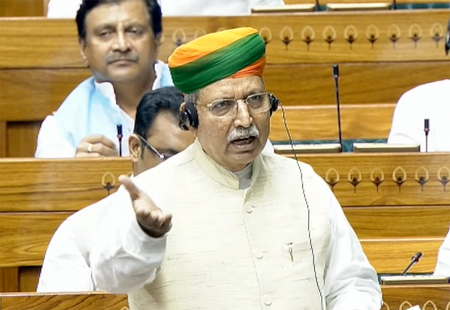
New Delhi, July 31 (IANS) An AI-based tool Legal Research Analysis Assistant (LegRAA), developed by the Artificial Intelligence Division of National Informatics Centre (NIC) and the NIC’s Centre of Excellence for eCourts (CoEE) to assist judges in legal research is in pilot testing phase, the Centre told the Lok Sabha on Friday.
Minister of State (MoS) for Law and Justice Arjun Ram Meghwal, in a written reply, said, “Another AI-based tool, Digital Courts 2.1, has been developed by the Centre of Excellence for eCourts (CoEE) at NIC in Pune as an integrated digital case management platform.”
“It provides a single-window interface for case-related information and incorporates AI-enabled features such as voice-to-text transcription and translation to assist Judges and Judicial Officers in dictation of court orders and judgments,” he said, adding that this tool is also in pilot testing phase.
MoS Meghwal said the operational framework governing the deployment and future use of AI-based solutions is decided in accordance with the Rules of Business and the policies of Supreme Court of India and respective High Courts.
The Minister of State said the eCourts Mission Mode Project, under the National e-Governance Plan, is being implemented by Department of Justice in coordination with eCommittee of the Supreme Court.
“Under the Phase-III of the Project, there is a provision for adoption of emerging technologies, including Artificial Intelligence (AI) to enhance judicial efficiency, for which an amount of Rs 53.57 crore has been earmarked under the Future Technological Advancements component,” he added.
In reply to a separate query in Lok Sabha, MoS Meghwal said the Designing Innovative Solutions for Holistic Access to Justice (DISHA) 2.0 Scheme is a Central Sector Scheme for pan-India implementation, including all the districts of Gujarat, for the period of 2026-31.
DISHA 2.0 aims at leveraging technology to develop and enhance the outreach of people-friendly solution platforms for legal services.
He said the scheme includes four components — Tele-Law: Reaching the Unreached (free pre litigation advice to all); Nyaya Bandhu (Pro-Bono legal Services) Programme; Legal Literacy and Legal Awareness Programme and VIDHI (Vision for Integrated Delivery of Harmonised Legal Initiatives)-Sanjeevani.
The monitoring of the progress of the scheme is envisaged through VIDHI- Sanjeevani, a Centralised Integrated Dashboard apart from regular review meetings, field visits, and direct feedback by way of regional workshops and through a dedicated Programme Management Unit.
–IANS
rch/khz
