


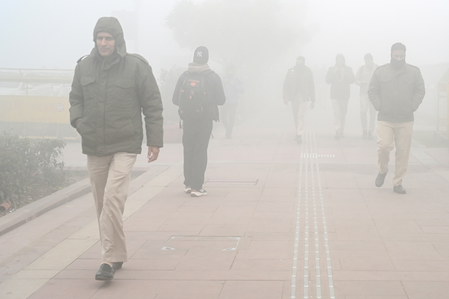
Air pollution in the National Capital Region (NCR), including Delhi, Noida, and Ghaziabad, has hit unprecedented levels recently, with the Air Quality Index (AQI) entering the “severe” category. This alarming pollution has sparked serious health worries due to the persistently high pollution levels. In various areas, the AQI has surpassed 450, nearing the 500 mark.
Owing to the hazardous pollution, the entire NCR is facing conditions akin to a gas chamber, with Delhi particularly affected. Residents are grappling with extremely harmful air quality, significantly disrupting daily life. Most air quality monitoring stations in Delhi have reported AQI readings firmly in the “severe” range.
Specific areas in Delhi like Anand Vihar, Ashok Vihar, Bawana, Chandni Chowk, Jahangirpuri, Rohini, Vivek Vihar, and Wazirpur have recorded AQI levels ranging from 442 to 473, emphasizing the widespread pollution crisis in the capital. Other parts of Delhi, including ITO, R.K. Puram, Sonia Vihar, and Mandir Marg, have also reported concerning AQI figures.
Even the IGI Airport Terminal-3 area in Delhi registered an AQI of 339, falling into the “poor to severe” category. Pollution levels in neighboring cities like Noida and Ghaziabad are equally alarming, with areas like Sector-62, Sector-1, Sector-116, Indirapuram, Loni, Sanjay Nagar, and Vasundhara reporting high AQI levels.
The Indian Meteorological Department has noted a thick layer of dense fog and smog enveloping the entire NCR, with dense fog recorded on January 19. Experts attribute the worsening air quality to high humidity levels and low wind speed, trapping pollutants near the ground. Authorities have enforced Phase 4 of the Graded Response Action Plan to address the severe pollution levels, including stringent checks on vehicles entering Delhi and restrictions on construction activities.
Environmental experts have cautioned that without significant changes in weather conditions and increased wind speeds, the pollution situation may deteriorate further in the upcoming days. The public has been advised to minimize outdoor activities, wear masks for protection, and take extra care of children and the elderly, who are most vulnerable to the adverse effects of severe air pollution.
