


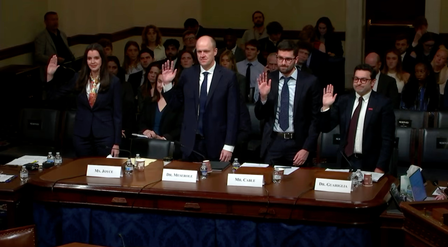
Artificial intelligence is revolutionizing cybersecurity, offering new defense tools while also providing avenues for criminals and hostile entities to target critical infrastructure, as highlighted by technology experts and lawmakers at a US Congressional hearing. President Donald Trump’s recent executive order directed federal agencies to establish a framework for assessing advanced AI cyber capabilities and broadening access to cutting-edge AI models for government and infrastructure operators. Experts emphasized that AI is hastening the discovery of software vulnerabilities, escalating cyber attack speeds, and heightening competition between the US and China.
During the hearing, members of the House Homeland Security Subcommittee on Cybersecurity and Infrastructure Protection were informed that AI models are reshaping the threat landscape, urging the federal government to swiftly grasp their potential. Sandra Joyce from Google Threat Intelligence Group noted the use of AI by cyber criminals, citing instances where AI was employed to craft zero-day exploits. Attackers are leveraging AI to swiftly identify vulnerabilities and navigate networks faster than conventional security responses allow.
Chris Meserole, Executive Director of the Frontier Model Forum, cautioned about the dual nature of advanced AI systems, which can safeguard or endanger depending on the user. He highlighted the risk of foreign competitors utilizing “adversarial distillation” to mimic advanced AI capabilities without safety measures, potentially posing threats to US critical infrastructure. Jack Cable, CEO of Corridor Security, stressed that AI is amplifying both the magnitude and pace of cyber threats, emphasizing the need for proactive vulnerability prevention strategies.
The discussion also underscored China’s prominence in the global AI landscape, with concerns raised about the widespread adoption of low-cost Chinese AI systems across various sectors if the US loses its competitive edge. The hearing emphasized the importance of maintaining AI leadership to safeguard national security interests, especially in light of Chinese cyber groups’ demonstrated ability to breach critical infrastructure networks. Democratic lawmakers expressed apprehensions regarding privacy, surveillance, and civil liberties, with calls for stronger safeguards and transparency requirements to mitigate potential government surveillance expansions due to AI advancements.
