


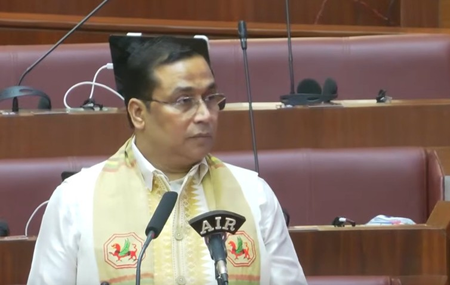
Assam Finance Minister Jayanta Malla Baruah presented the state Budget for 2026-27 in the Assembly, focusing on job creation, infrastructure development, healthcare, education, and welfare. The Budget highlighted 10 key initiatives to drive the state’s growth, with a strong emphasis on creating two lakh government jobs.
The Budget also ensured the continuation of welfare schemes like Orunodoi and Nijut Moina, along with other social security initiatives. A significant push for aviation infrastructure was announced, aiming to transform Guwahati Airport into an 80-million-passenger-capacity airport, enhancing connectivity in Assam.
An investment of Rs 72,000 crore in the power sector was proposed to support thermal, hydro, solar, and battery energy storage projects. This investment aims to strengthen the state’s power infrastructure to meet future energy demands effectively. Additionally, Rs 4,000 crore was allocated for irrigation projects in the Brahmaputra valley to boost agriculture productivity.
The Budget also emphasized welfare programs for tea garden workers, focusing on improving healthcare, nutrition, and living conditions in tea-growing regions. Plans to recruit 33,000 healthcare personnel were announced to enhance public health services across the state. The government also reiterated its commitment to recruiting teachers in educational institutions to address faculty shortages and improve higher education infrastructure.
To enhance youth employability, skill development initiatives in areas like artificial intelligence, visual effects, and foreign languages were introduced. The government aims to train young individuals in English, Japanese, and Korean to improve their job prospects. Infrastructure proposals include accelerating work on roads, bridges, rail, and airport connectivity, along with the construction of Dibrugarh as Assam’s second capital for balanced regional development.
The Budget reflects the government’s focus on employment-led growth, infrastructure development, and long-term economic progress while ensuring the continuation of welfare measures for various sections of society.
