


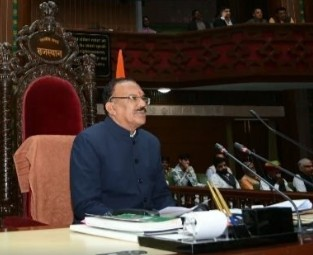
Assembly Speaker Vasudev Devnani will host an all-party gathering prior to the State Legislative Assembly’s Budget Session, set to commence on January 28. The official notification for the Budget Session was released by the Assembly Secretariat after receiving approval from the Governor. The session is scheduled to start with the Governor’s address and is anticipated to run until March.
In the Governor’s speech, the government will highlight its key accomplishments. Following the Governor’s address and tributes to deceased leaders on January 28, the House proceedings will be adjourned. Subsequently, the Business Advisory Committee (BAC) will convene to determine the agenda and timetable for the Budget Session. A discussion on the Governor’s address is expected to span three to four days, followed by the government’s response. A potential week-long recess may follow, with the budget likely to be presented in the second week of February, pending a final decision.
During the Budget Session, the government is poised to unveil new initiatives and potentially introduce multiple schemes. A bill is in the works to eliminate the two-child policy in Panchayati Raj and urban local body elections, with separate bills planned to amend the Panchayati Raj Act and the Municipal Act. Several other bills may also be tabled during the session.
The upcoming Budget Session is anticipated to be contentious. Leader of Opposition Tikaram Jully affirmed that the Congress Legislature Party is ready to challenge the government comprehensively. Jully emphasized that this session will serve as an evaluation of the government’s performance over the past two years.
Jully criticized the government for announcing grand plans in the budget only to retract them later, citing feasibility concerns. He expressed dismay over feasibility assessments being conducted post-announcement instead of beforehand, labeling the forthcoming budget as a mere formality. Jully further accused the government of surpassing Fiscal Responsibility and Budget Management (FRBM) limits, with a significant portion of taxpayers’ funds directed towards interest payments. He highlighted a concerning trend of escalating debt levels at both the central and state government levels.
