


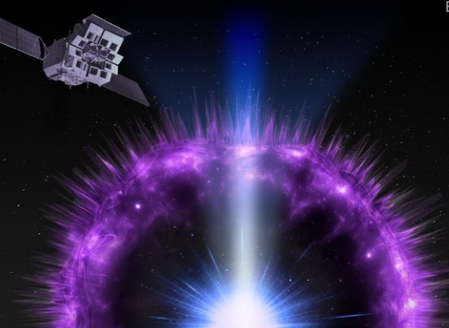
An Australian-led study, published in Nature, has discovered evidence of a unique type of exploding star, providing insights into one of the most catastrophic events in the universe. The research, utilizing gravitational wave observations, delves into how the largest stars conclude their life cycles, supporting the existence of a long-anticipated “forbidden gap” in black hole masses, as per a statement from Monash University in Australia.
Most massive stars, as they near the end of their lifespan, collapse into black holes characterized by gravity so intense that even light cannot escape. However, it is believed that exceptionally massive stars reach temperatures high enough to disintegrate in a “pair-instability supernova,” an exceptionally violent explosion that annihilates the star entirely, leaving no black hole in its wake, as reported by Xinhua news agency, citing the Monash University statement.
The study’s researchers have pinpointed a “forbidden range” of black hole masses exceeding 45 times that of the Sun, where black holes originating from stars are uncommon. This gap aligns with theories proposing that such stars detonate through pair-instability, resulting in no remnants left behind. Tong Hui, the project lead and a PhD candidate at Monash University, highlighted the identification of this forbidden mass range where stars seemingly fail to form black holes.
According to Tong Hui, “The only black holes in this mass range are made from merging smaller black holes, rather than directly from stars.” Confirming the presence of this gap would aid in resolving a significant query regarding the life and demise of the most massive stars, as well as the genesis of black holes, the researchers emphasized.
