


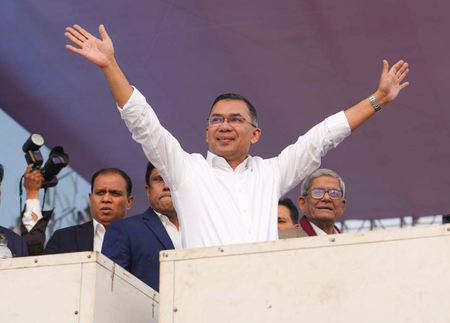
Even as the Bangladesh Nationalist Party (BNP) appears to be heading towards a significant victory in the country’s 13th national election, the outcome is being viewed as highly consequential and contentious. Initial reports suggest that the BNP-led alliance is gaining an edge over its competitors, particularly the Bangladesh Jamaat-e-Islami, as anticipated by opinion polls. The Jamaat’s hopes for a last-minute turnaround seem to have been dashed as the election results unfold.
The election results indicate a potential overwhelming mandate for the BNP, potentially hindering any reconciliation between the former political allies turned adversaries. Efforts are reportedly underway in Dhaka to unite the BNP and Jamaat, emphasizing the importance of demonstrating unity among political leaders to both domestic and global audiences. The final outcome of the election will shed light on whether the “floating voters,” including Awami League supporters and minority electors, have shifted their support towards the BNP.
Both the BNP and Jamaat share overlapping voter bases rooted in nationalism and conservative values, positioning them as strong contenders in the election. The current political landscape contrasts with previous coalition governments, signaling a shift in power dynamics. The election process has drawn criticism from former Prime Minister Sheikh Hasina, who raised concerns about low voter turnout, violence, and irregularities in voter numbers in Dhaka. Despite differing claims on voter turnout, the election has sparked debates on the legitimacy and transparency of the electoral process.
