


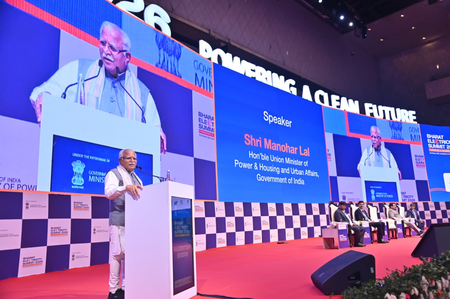
The Bharat Electricity Summit’s (BES) inaugural edition wrapped up successfully, with India reiterating its dedication to establishing a future-ready, technology-oriented, and investment-welcoming energy environment. The Indian Carbon Market Portal was introduced, anticipating the commencement of trading soon, a significant move in climate finance. The summit’s outcomes are poised to play a crucial role in shaping policies, fostering alliances, and hastening the shift towards a dependable, cost-effective, and eco-friendly energy future, as per an official statement.
In his closing speech at the event, Power Minister Manohar Lal highlighted productive dialogues with numerous countries, particularly African nations. It became evident that India and African nations have mutually beneficial prospects for collaboration in the power sector and beyond. The summit facilitated several high-level bilateral meetings with nations like Malawi, Tajikistan, Mauritius, Kyrgyzstan, and Russia, along with industry players such as Africa50 and international delegations, focusing on cross-border electricity trade, renewable energy cooperation, and transmission infrastructure development.
Inspired by Prime Minister Narendra Modi’s vision, India is swiftly progressing towards achieving 500 GW of non-fossil fuel capacity by 2030, having surpassed the milestone of over 50% non-fossil capacity. Initiatives like One Sun, One World, One Grid underscore India’s dedication to global energy collaboration, emphasized Manohar Lal.
The nation’s total installed capacity has exceeded 520 GW, showcasing one of the fastest expansions worldwide. The transmission network has grown to over 5 lakh circuit kilometers, and the renewable energy capacity has seen substantial growth, with solar capacity surging from 2.8 GW in 2014 to over 143 GW presently. The demand for electricity is expected to surge by over 30% by 2030, driven by emerging sectors like AI-enabled data centers and electric mobility.
