


Cambodia’s Angkor Archaeological Park had 955,131 international visitors in 2025, marking a 6.7% decrease from the previous year. The park’s revenue from ticket sales amounted to 44.7 million US dollars, also down by 6.5% compared to the previous year. The main sources of foreign tourists to the park included the United States, Britain, France, China, and South Korea.
In December 2025, the park welcomed 87,936 foreign tourists, generating 4.23 million US dollars in revenue. This reflected a significant decline of 30% in visitor numbers and 28.5% in revenue compared to December 2024. Situated in northwest Siem Reap province, the park features 91 ancient temples constructed between the ninth and 13th centuries.
Thong Mengdavid, Deputy Director at the China-ASEAN Studies Centre of the Cambodia University of Technology and Science, highlighted Cambodia’s new pilot visa-free policy for Chinese citizens from June 15 to October 15, 2026. This policy is expected to boost Cambodia’s tourism growth by reducing travel barriers and attracting more visitors. With targeted promotions and improved tourism infrastructure, Chinese arrivals at the Angkor Archaeological Park could surpass pre-pandemic levels in the future.
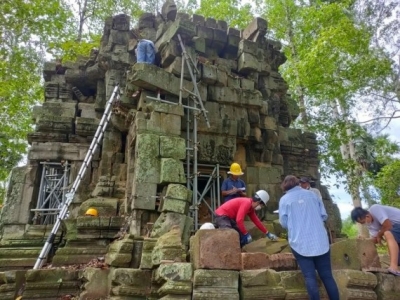
India played a significant role in supporting the restoration of the ancient temple at Angkor Wat, a symbol of India-Cambodia shared heritage. The Archaeological Survey of India conducted the first restoration work at Angkor Wat temple from 1986 to 1993. India’s assistance in temple restoration in Cambodia dates back to 1980, and its contributions are still valued by the Cambodian government and public. In response to Cambodia’s request, India also agreed to restore the Ta Prohm temple in Angkor Archaeological Park, with restoration work initiated in 2003.
