


Canadians are set to benefit from India’s intellectual capital, boosting prosperity in a competitive global landscape. Recent advancements in educational collaboration between Canada and India present a crucial opportunity to revive people-to-people connections affected by visa constraints, as highlighted in a report. Initiatives like CA $100 million in scholarships, 300 Mitacs internships, and various inter-university agreements are anticipated to enrich student exchanges and collaborative research, significantly contributing to Canada’s economy.
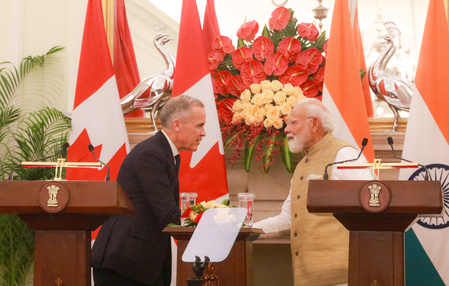
Canadian Prime Minister Mark Carney’s recent trip to India marked a significant progression, unveiling 13 new inter-university partnerships in Mumbai and Delhi. Noteworthy collaborations include the University of Fraser Valley teaming up with Panjab University and a partnership between Algoma University in Canada and Parul University in India. These collaborations aim to facilitate student and faculty exchanges, joint degree programs, and collaborative research in artificial intelligence and clean technologies.
Foreign Minister of Canada Anita Anand emphasized that these agreements would enhance collaborative research efforts and pave the way for hybrid campuses, directly addressing enrollment declines linked to recent visa restrictions. The visit initiated the Canada-India Talent and Innovation Strategy, involving 24 education-focused Memorandums of Understanding (MoUs). Commitments to dual-degree programs, offshore Canadian campuses in India, and skills development in emerging technologies were underscored in a joint statement by Carney and the Indian Prime Minister.
A significant aspect of these initiatives is the allocation of CA $100 million in scholarships, supporting up to 200 fully funded positions for Indian students and offering similar opportunities for Canadians. For instance, the University of Toronto pledged up to $25 million for over 220 Indian scholars, while Mitacs extended its memorandum with India’s All India Council for Technical Education (AICTE), securing 300 annual Globalink Research Internships for elite Indian undergraduates at Canadian universities starting in summer 2027. These internships cover various fields and are supervised by Canadian faculty to drive innovation.
Moreover, the report highlighted the establishment of hybrid study centers like Dalhousie University’s collaboration with IIT Tirupati, enabling students to commence studies in India before transitioning to Canada. The presence of nearly two million Canadians of Indian origin underscores how these initiatives strengthen familial and commercial networks, cultivating future-ready talent pools. Indian interns become lifelong advocates, while graduates contribute to economic growth through post-graduation work permits. The implementation of these initiatives is overseen by a Joint Working Group, with its inaugural report scheduled for July 2026.
