


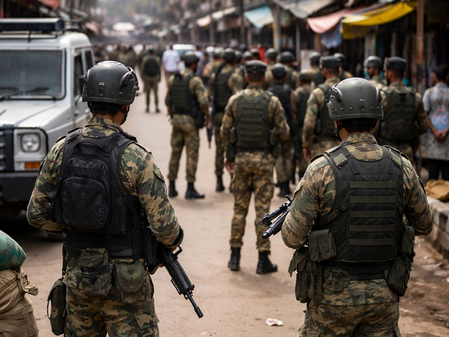
Top officials of the Central Armed Police Forces (CAPF) have completed a technology-driven security plan for the upcoming West Bengal Assembly elections in 2026. The first phase is set for April 23, followed by the second phase on April 29. Directors General of CRPF, BSF, CISF, SSB, and ITBP met in Salt Lake to ensure a smooth and transparent election process.
The focus of the high-level meeting was on enhancing inter-agency coordination to guarantee a fair and secure electoral environment. Quick Response Teams (QRTs) deployment and anti-sabotage measures were reviewed to strengthen the “Integrated Security Grid.” The aim is to effectively handle any potential disruptions in collaboration with local law enforcement.
The primary goal of these security forces is to facilitate a transparent and fear-free voting process for all citizens. With the first phase covering 152 constituencies on April 23, this joint effort aimed to align operational strategies for the personnel on the ground.
Following an internal review, a joint session was conducted at the 3rd Signal Centre, CRPF, Salt Lake. The meeting, led by Salabh Mathur, IG, CRPF, brought together top officials from CISF, BSF, CRPF, ITBP, SSB, and West Bengal Police, along with the Election Commission’s Police Advisor.
Director General of CISF, Praveer Ranjan, emphasized the mission in West Bengal as beyond routine security, focusing on upholding the integrity of the ballot. He urged personnel to function as a unified and technologically proficient “One Election Force.” As the state nears the first phase on April 23, CAPF leadership stressed the importance of leading by example and maintaining discipline and turnout standards.
The security deployment includes extensive surveillance of sensitive areas and strict adherence to the Election Duty Handbook to ensure full compliance with Election Commission of India (ECI) guidelines. The meeting concluded with a boost in morale among the ranks, assuring the public of a secure and peaceful voting atmosphere in West Bengal.
