


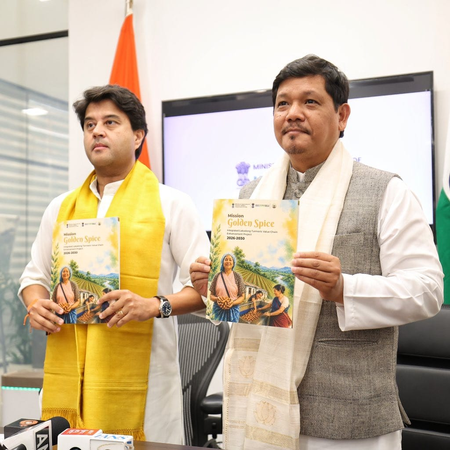
The Central government has initiated a Rs 175.45-crore integrated development mission to elevate Meghalaya’s Geographical Indication (GI)-tagged Lakadong turmeric as a premium global product. The mission aims to enhance farmers’ incomes and expand cultivation in the state over the next five years. Launched by Union Minister Jyotiraditya M. Scindia, the Meghalaya Lakadong Turmeric Integrated Development Mission targets over 17,500 farmers in West Jaintia Hills and East Jaintia Hills.
The initiative focuses on strengthening every aspect of the Lakadong turmeric value chain, including cultivation, quality certification, processing, branding, value addition, and exports. Funding for the project comes from the Ministry of DoNER, the North Eastern Council (NEC), the Union Ministry of Agriculture and Farmers’ Welfare, and the Meghalaya government. Referred to as “Mission Golden Spice,” the project aligns with Prime Minister Narendra Modi’s vision of leveraging the Northeast’s agricultural strengths for India’s economic growth.
The mission’s objectives include enhancing post-harvest infrastructure, boosting processing capacity, reducing distress sales, and increasing value addition to ensure better returns for farmers. By 2030, farmers’ remuneration is expected to double to approximately Rs 80 per kg. The program also aims to expand Lakadong turmeric cultivation from 2,500 hectares to nearly 7,000 hectares during the implementation phase.
Furthermore, the mission seeks to establish Lakadong turmeric in premium international markets such as the United States, the European Union, Japan, and Gulf countries. Emphasizing women-led development, the initiative has garnered global attention following PM Modi’s presentation at the G7 Summit. Meghalaya Chief Minister Conrad K. Sangma highlighted the exceptional quality of Lakadong turmeric, attributing it to the unique soil composition and ecological conditions of the Jaintia Hills.
Sangma expressed confidence that the mission would create sustainable livelihood opportunities for numerous farmers and entrepreneurs, particularly women engaged in cultivation and processing activities. The state government has introduced financial support mechanisms to provide working capital to farmers, self-help groups, and producer organizations without conventional banking collateral requirements. The mission aims for an annual Lakadong turmeric production of nearly 49,400 metric tonnes by 2030, with women expected to contribute significantly to processing and institutional activities.
