


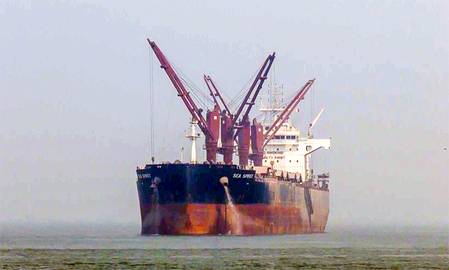
Iran’s proposal to create a safe corridor in the Strait of Hormuz has faced resistance from China, as per a recent report. The initiative aimed to address disruptions in shipping traffic affecting major Asian economies. Chinese vessels reportedly avoided using the safe corridor offered by Iran for a period of 10 days.
According to the report by Turkey’s Anadolu Agency, Tehran declared on March 13 its intention to monitor ship movements in a designated corridor within its territorial waters, spanning the Larak and Kish islands. Chinese shipowners mentioned being requested to pay passage fees or transport cargo on behalf of Iran during inspections conducted by IRGC officials in the corridor.
The report highlighted that a Chinese vessel eventually traversed the corridor between Larak and Kish islands on March 23 after a delay of 10 days. It noted an incident on March 16 involving a large crude carrier from the Chinese company Cosco, which opted to avoid entering the Persian Gulf. Instead, the vessel took a longer route through the Bab el-Mandeb Strait into the Red Sea, ultimately docking in Yanbu, Saudi Arabia.
Allegations surfaced regarding a special oil trade relationship between China and Iran facilitated by the use of Chinese Yuan. While claims suggested preferential treatment for Chinese vessels in the strait, international shipping records reportedly contradicted these assertions. The trade arrangement involves China purchasing Iranian oil at discounted rates through petroyuan agreements, exchanging goods for the oil’s value in Chinese Yuan. Despite occasional complaints from Tehran about trade disadvantages, this system remains a crucial source of support for Iran under sanctions.
The report warned of potential shocks in the global energy market due to disruptions in energy supply, projecting a prolonged resolution period. Major Asian economies, particularly China and India, heavily reliant on Gulf imports, are grappling with significant challenges arising from shipping disruptions. China, for instance, acquires 45% of its oil from countries like Saudi Arabia, Iraq, the UAE, and Kuwait, while also importing LNG from the UAE and Qatar, constituting 30% of its total imports.
