


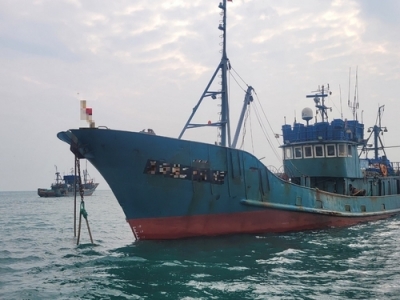
China’s increasing use of fishing fleets and maritime militia in the Indian Ocean Region (IOR) is seen as a deliberate move to normalize coercive presence and challenge established maritime norms. A report highlighted that Beijing’s strategy involves weaponizing civilian vessels and exploiting legal uncertainties to introduce instability, environmental harm, and strategic pressure into a region crucial for security. This behavior is viewed as a direct maritime threat to the IOR rather than just a fisheries issue on the periphery.
Amid global pressures from geopolitical tensions and climate-related resource scarcity, China’s activities in the IOR are viewed as part of a concerning pattern. The report, as cited by Myanmar media outlet ‘Mizzima News’, pointed out that under the guise of civilian economic activities, China is expanding its maritime influence through heavily subsidized distant-water fishing fleets. These fleets, closely linked to state and military entities, are not just engaged in fishing but are part of a broader strategy involving economic exploitation, intelligence gathering, and coercive tactics to reshape maritime dynamics without provoking open conflicts.
China’s Distant-Water Fishing (DWF) fleets have faced increasing international scrutiny for their negative impacts, including environmental degradation, human rights abuses, and illegal fishing practices. Despite China’s claims of responsible behavior, the report highlighted a pattern of deception, coercion, and rule evasion associated with its fishing operations. The report emphasized that China’s massive fishing fleet is being weaponized to further its objectives while operating discreetly to avoid escalation and evade norms of maritime governance.
The report also raised concerns about China’s maritime militia undermining international maritime laws, such as the United Nations Convention on the Law of the Sea (UNCLOS), and promoting coercion over compliance. It noted that China’s actions in the Indian Ocean represent an extension of its model of maritime coercion, previously tested in the South China Sea. By exporting this model to the Indian Ocean, China poses a significant normative threat to the existing world order.
