


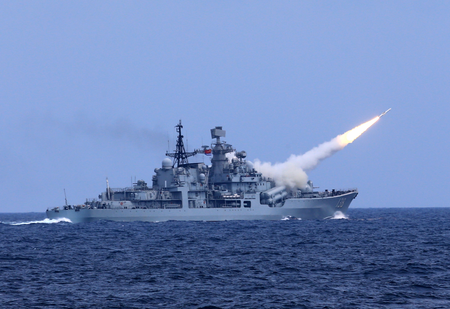
The timing of a recent nuclear-capable missile launch from a Chinese submarine is under scrutiny, with a report pointing out that the US focus on West Asia conflicts may have overshadowed this event. The launch coincided with heightened tensions between the US and Iran, diverting American attention and resources to the Gulf region.
The report, authored by Divya Malhotra, suggests that while the West Asia conflict does not necessarily link to China’s test, Beijing maintains that the timing aligns with its annual training schedule. However, the launch occurred when major powers capable of responding to China’s nuclear signaling were preoccupied, a fact not lost on regional planners in Tokyo, Canberra, and New Delhi.
The significance of the missile landing in the South Pacific Nuclear Free Zone is highlighted, emphasizing the broader implications for New Zealand and the region’s nuclear stability. The report recalls previous Chinese missile tests, indicating a strategic shift towards a more visible and assertive nuclear posture in international waters.
Malhotra observes a trend in China’s increasing transparency regarding its nuclear capabilities, moving away from secrecy towards a more open validation of its arsenal. The recent submarine-launched missile test is seen as a deliberate step towards establishing continuous at-sea deterrence, akin to established practices by other nuclear powers like the US, France, and the UK.
