


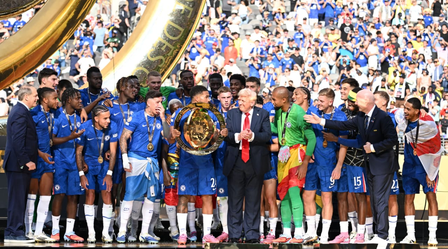
In a year without a major men’s international tournament, club football took center stage, notably with Paris Saint-Germain (PSG) standing out in Europe. PSG secured the UEFA Champions League title by defeating Inter Milan 5-0, showcasing the team’s cohesion over individual star power. Ousmane Dembele’s performance led to him being named the Ballon d’Or winner and FIFA Best Men’s Player.
Liverpool clinched the Premier League title under Arne Slot’s management, succeeding Jurgen Klopp. Despite significant summer signings, Liverpool faced challenges as new players struggled to integrate, putting pressure on Slot. Barcelona, led by Hansi Flick, triumphed in La Liga despite financial constraints and played at the former Olympic Stadium while Camp Nou underwent renovations.
Real Madrid faced a turbulent year, missing out on league success and exiting the Champions League early under Carlo Ancelotti. Xabi Alonso took over before the Club World Cup, where Madrid fell to PSG. Bayern Munich reclaimed the Bundesliga title, and Napoli secured Serie A with a 2-0 victory over Cagliari.
The expanded Club World Cup highlighted European dominance, with prize money distribution favoring European clubs. Concerns arose about player workload and extreme weather conditions affecting the tournament. Looking forward, Spain, England, and Argentina are expected to be strong contenders in the 2026 World Cup, with uncertainty surrounding Lionel Messi’s participation.
Inter Miami, led by Messi, won the MLS title in the United States, while Flamengo triumphed in the Copa Libertadores in South America. Al-Hilal’s Club World Cup performance and Al-Ahli’s AFC Champions League victory emphasized the impact of significant investments in the Saudi Pro League. England’s women’s team rose to the top by defeating Spain in the European Championship final, with Spain later winning the UEFA Nations League under new coach Sonia Bermudez.
