


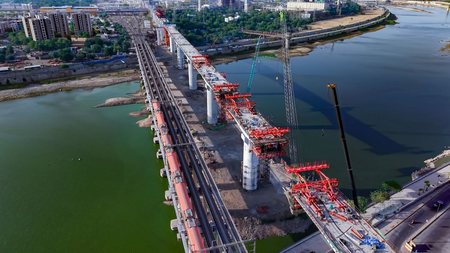
Construction of a 36-meter-high bridge over the Sabarmati River for the Mumbai-Ahmedabad High-Speed Rail project is advancing well, with key structural milestones achieved. The bridge, about 480 meters long and as tall as a 12-storey building, is being constructed alongside the Western Railway’s Ahmedabad-Delhi main line. It is positioned between the proposed Sabarmati and Ahmedabad high-speed rail stations, close to Sabarmati station and around four kilometers from Ahmedabad station.
All eight circular piers, ranging from 6 to 6.5 meters in diameter, have been finished, with four in the riverbed, two on the banks, and two outside the riverbanks. The pier heights vary from approximately 31 to 34 meters, strategically placed to minimize disruption to the river’s natural flow.
The bridge consists of five spans of 76 meters and two spans of 50 meters, with each span built using 23 segments cast in situ. Employing the balanced cantilever method, the construction proceeds without scaffolding beneath the structure, with segments joined sequentially and post-tensioned to create a continuous deck.
Foundation and substructure works are complete, signifying a significant construction phase. Three of the 76-meter spans are finished, while work continues on the remaining superstructure, including pier head construction and segment casting. Measures are in place to maintain uninterrupted water flow in the Sabarmati during construction, including temporary embankments with Hume pipe culverts and a natural discharge channel to facilitate water movement.
The Mumbai-Ahmedabad High-Speed Rail corridor, spanning approximately 508 km, is managed by the National High Speed Rail Corporation Limited. The project involves various river crossings and intricate structures, with multiple bridges already finished and others, like those over major rivers such as the Narmada and Tapti, in advanced stages. Recent updates indicate substantial progress along the corridor, with significant viaduct and pier work completed, and construction progressing simultaneously at stations, depots, and bridge sites.
