


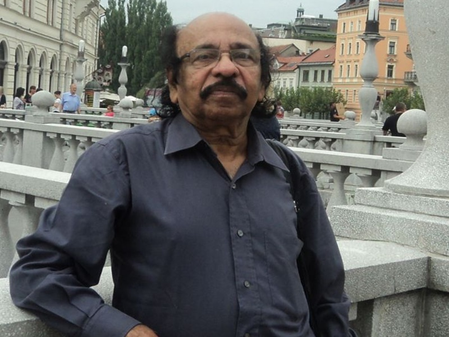
The controversy sparked by poet K. Satchidanandan’s comments on government alternation persists in Kerala’s political and cultural spheres. Following the initial backlash, the former Sahitya Akademi Secretary took to social media to elaborate on his stance within an ideological and democratic framework. Many interpreted Satchidanandan’s original statement as a challenge to the ruling Left Democratic Front’s bid for a third consecutive term.
The poet’s remarks faced strong criticism, especially from CPI(M)-aligned groups, accusing him of undermining the Left’s position at a critical juncture. The discourse transcended party affiliations, evolving into a broader discussion on loyalty, ideology, and dissent. In his recent social media post, Satchidanandan clarified that his views were grounded in Marxist principles and democratic ideals rather than immediate electoral considerations.
Satchidanandan referenced contemporary Marxist philosopher Jacques Rancière, emphasizing the concept of subaltern democracy as a defense against authoritarianism. He argued that democracy should amplify marginalized voices and empower disadvantaged groups, cautioning against development models that exacerbate inequality. The poet highlighted the importance of countering power monopolies and preserving democratic alternatives, drawing from works like ‘Hatred of Democracy’ and ‘How Democracies Die.’
Responding to online critics, Satchidanandan recounted his political activism history, including involvement in labor and tribal movements, experiences during the Emergency period, consistent warnings about fascism’s rise, and resignation from the Sahitya Akademi post the scholar Kalburgi’s murder. He stressed that his literary accolades were earned on merit, devoid of seeking favors or positions. As Kerala braces for a polarized election season, Satchidanandan’s intervention ensures that the discourse on power, ideology, and democratic rejuvenation remains a prominent public conversation.
