


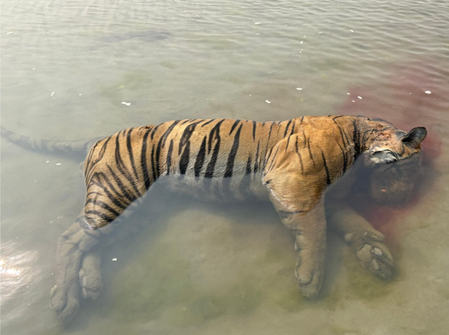
Another dead tiger has been discovered in Assam’s Kaziranga National Park and Tiger Reserve (KNPTR), less than a month after two other tiger carcasses were found, officials reported. The male tiger, around 12 to 13 years old, was found in the western part of the Mandir Baneshwar Anti-Poaching Camp area of Burapahar Range Ghorakati. A post-mortem examination and carcass disposal committee, led by KNPTR Director Sonali Ghosh, has been formed to follow the Standard Operating Procedures of the National Tiger Conservation Authority.
Preliminary findings from the post-mortem indicate that the tiger’s death was a result of infighting. In a separate incident, a tigress, aged approximately three to four years, was discovered dead on January 18 in the Kathpora area of the Bagori Western Range. Post-mortem results suggested that the female tiger also died due to infighting. Additionally, on January 14, the carcass of a young male Royal Bengal tiger, aged around two to three years, was found in the Eastern Range at Gamiri under the Biswanath Wildlife Division of KNPTR.
The KNPTR Director promptly established a committee to oversee the post-mortem examination and disposal of the carcass in accordance with NTCA guidelines. Initial veterinary assessments indicated that the tiger’s death may have been due to natural causes or infighting. Kaziranga National Park and Tiger Reserve, India’s seventh UNESCO World Heritage Site, is home to the renowned ‘Big Five’ wildlife species. The park currently houses a significant population of various endangered species, including greater one-horned rhinoceroses, Bengal tigers, Asian elephants, wild water buffaloes, and eastern swamp deer.
Situated across Golaghat, Nagaon, Sonitpur, and Biswanath districts, the park has been a significant revenue generator, surpassing Rs 10.90 crore in 2024-25 and over Rs 8.81 crore in 2023-24. Comprising three forest divisions, namely Eastern Assam Wildlife Division (Bokakhat), Biswanath Wildlife Division (Biswanath Chariali), and Nagaon Wildlife Division (Nagaon), KNPTR remains a vital conservation area for India’s diverse wildlife.
