


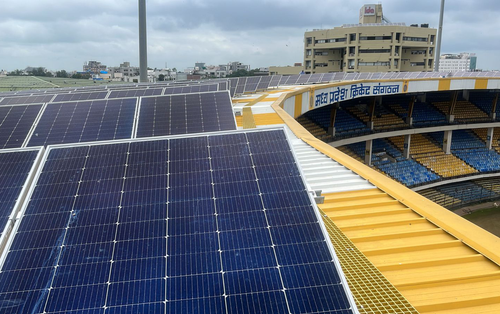
Rapidly decreasing costs of electrotech, such as solar panels and batteries, have paved the way for countries like India to explore new energy avenues that were not viable a decade ago during China’s power sector expansion. Back in 2004, when China surpassed 1,500 kWh of electricity use per capita, coal generation was significantly cheaper than emerging solar photovoltaics (PV), leading to coal dominating about 70% of China’s electricity growth over ten years.
In contrast, as India surpasses the 1,500 kWh mark in electricity use per capita, the combined costs of solar and storage are now approximately half that of new coal plants. This cost gap is widening due to the consistent decline in solar and battery costs following predictable learning curves, while coal power is becoming more costly with reduced utilization, as outlined in an article by Ember, a global energy think tank.
Moreover, in the transportation sector, around 2011, when China’s road transport oil demand hit 150 liters of gasoline equivalent per capita, batteries were ten times pricier than they are today, and the electric vehicle industry was in its infancy. On the other hand, India’s road oil demand, currently at 96 liters per capita, is unlikely to ever reach 150 liters. Electric vehicles are already competitively priced compared to internal combustion engines, leading to a decrease in the country’s oil import expenses and pollution levels.
“The energy pathway that is economically viable for India today, as it undergoes rapid industrialization, differs from what was suitable for China during a similar phase,” the article emphasizes. India is already making significant progress in the early stages of renewable energy and electric vehicles development, outperforming China in these aspects.
India achieved 5% solar energy contribution to the total generation at around $9,000 GDP per capita, a milestone that China reached at approximately $23,000. The rapid growth of solar energy is being followed by batteries, with the proportion of renewable tenders combined with battery storage rising from about 12% in 2021 to half in 2024, according to the article. Furthermore, India’s coal-fired generation is projected to decline annually in 2025, while the ascent of solar energy remains uninterrupted.
Studies by Ember and TERI forecast a plateauing coal demand in India until 2030. Similarly, the IEA’s Stated Policies scenario, which historically underestimated electrotech growth, predicts India’s coal demand in 2035 to be at similar levels to today. It is highly probable that India will reach $20,000 GDP per capita without coal generation ever matching the levels China had at $5,000, the article concludes.
