


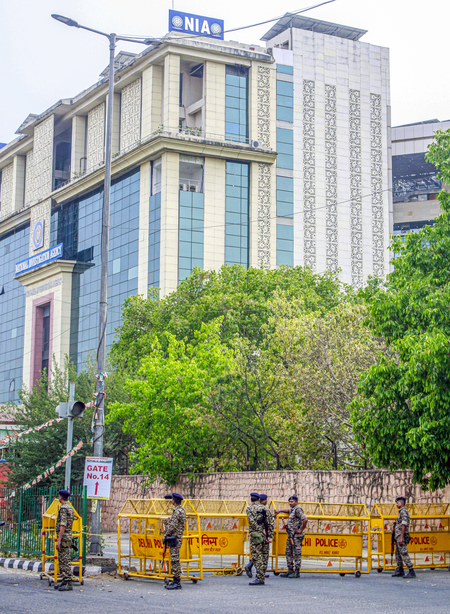
A Delhi court has granted permission to the National Investigation Agency (NIA) to hold proceedings at its headquarters in the case involving the arrest of seven foreign nationals accused of providing terror training in Myanmar. The Patiala House Court approved the NIA’s request citing security concerns and ordered that all future hearings be conducted at the NIA headquarters, where the accused will appear before the judge. The accused, including six Ukrainian nationals and an American citizen named Matthew Aaron VanDyke, were supposed to appear before the NIA court after their 11-day custody, but the NIA requested that subsequent hearings be held at its headquarters.
The court has instructed that the accused individuals must be presented before the designated judge at the NIA headquarters for further proceedings. The NIA has described the case as “extremely sensitive” with potential national and international implications, as the seven accused allegedly entered India on tourist visas, traveled to Mizoram, and illegally crossed into Myanmar. Investigations have revealed their connections with Myanmar-based ethnic armed groups and their involvement in weapon handling and drone operations training.
The NIA alleges that the accused facilitated the procurement and transportation of drones and electronic jamming equipment from Europe for training activities conducted across the border. Among the seven accused are Ukrainian nationals Petro Hubra, Taras Slyviak, Ivan Sukmanovskyi, Marian Stefankiv, Maksym Honcharuk, Viktor Kaminskyi, and American national VanDyke. VanDyke was arrested in Kolkata, while three Ukrainians were apprehended in Delhi and the remaining three in Lucknow. This case is part of a broader investigation by the NIA into an alleged international network of foreign mercenaries operating in India’s northeastern region.
Previous investigations suggested that the group had been active since 2024, training insurgent elements in Myanmar. Authorities are focused on identifying local facilitators and uncovering the larger conspiracy, including potential plans to use the northeastern corridor for transnational militant activities. The NIA continues its probe into the wider network, collaborating with various domestic and international agencies to trace all connections in the case.
