


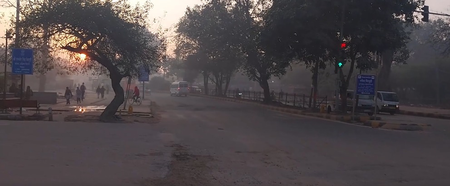
Residents of Delhi woke up to a foggy Friday morning with dense mist and cloudy skies, as the city’s air quality continued to be a concern. The day started with reduced visibility and cooler temperatures, while pollution levels remained worrying across various parts of the capital. Despite the concerns, there was a slight improvement in Delhi’s overall air quality on Friday morning.
Air pollution in Delhi was mainly in the ‘poor’ category, although some areas reported ‘moderate’ air quality. The city’s average Air Quality Index (AQI) stood at 231 at 6.00 a.m., according to data from the Central Pollution Control Board (CPCB). Recent rainfall episodes have helped in slightly reducing pollution levels compared to previous days.
Out of 39 air quality monitoring stations in Delhi, 13 stations recorded ‘moderate’ air quality, while 22 stations remained in the ‘poor’ range. However, certain areas like Jahangirpuri, RK Puram, Nehru Nagar, and Siri Fort experienced severe pollution levels, with AQI readings above 300, categorizing them as ‘very poor.’
Several locations in Delhi showed varying pollution levels, as per CPCB data. Areas like Anand Vihar, Ashok Vihar, Bawana, Burari Crossing, Dwarka Sector-8, ITO, Jawaharlal Nehru Stadium, Lodhi Road, Narela, Patparganj, Pusa, Rohini, and Sonia Vihar had different AQI readings. Neighboring Noida also reflected similar air quality trends with AQI readings at different sectors.
The India Meteorological Department (IMD) has forecasted the impact of another western disturbance on northwest India starting from February 2. Additionally, a subtropical westerly jet stream over northeast India is contributing to unstable weather patterns. These meteorological systems are expected to bring cloud cover, rainfall, and temperature fluctuations over the upcoming days.
IMD’s forecast for January 30 includes shallow to moderate fog during morning hours in Delhi, along with overcast skies. While minimum temperatures are expected to be above average, daytime temperatures will remain lower than usual. The IMD has also predicted rainfall and thunderstorms in Delhi and surrounding regions between January 31 and February 2, with a drop in minimum temperatures followed by a gradual rise.
Delhi witnessed its highest January rainfall in four years this month. The total rainfall for January reached 24 mm, the highest since 2022, with the wettest January day in recent years recorded on January 8, 2022, when the city received 40.6 mm of rainfall.
