


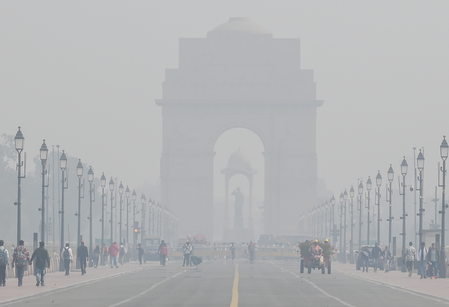
The air quality in Delhi worsened on Wednesday, with the Air Quality Index (AQI) reaching 294, categorizing it as ‘poor,’ as per the Central Pollution Control Board (CPCB). The Delhi-National Capital Region (NCR) is expected to have clear skies with mist in the morning, while temperatures will remain near seasonal averages, according to the India Meteorological Department (IMD).
Several monitoring stations in Delhi reported high AQI levels based on CPCB data. Areas like Anand Vihar, Bawana, Burari Crossing, Chandni Chowk, and DTU recorded AQI levels ranging from 290 to 365. Additionally, places such as Dwarka Sector-8, IIT Delhi, Jawaharlal Nehru Stadium, Mandir Marg, and Mundka also fell into the ‘poor’ category.
Noida in the NCR also experienced poor air quality, with different sectors reporting AQI levels between 268 and 328. Delhi Chief Minister Rekha Gupta emphasized the need for continuous, year-round efforts to control pollution. She inaugurated six Continuous Ambient Air Quality Monitoring System (CAAQMS) stations to enhance real-time air quality tracking in the capital and flagged off 100 ‘Vayu Rakshak’ vehicles for stricter pollution control enforcement.
The total number of CAAQMS stations in Delhi has now reached 46, making it the largest air quality monitoring network in any city in India. These stations are operated by various bodies, including the Delhi Pollution Control Committee (DPCC), India Meteorological Department/IITM, and CPCB. The initiative also involves deploying ‘Vayu Rakshaks’ for pollution control activities and monitoring traffic and emission violations.
The IMD forecasted maximum temperatures in Delhi to range from 24 to 26 degrees Celsius on February 11, with minimum temperatures between 10 and 12 degrees Celsius. Similar weather conditions are expected on February 12 and 13, with clear skies and light morning mist. Winds are predicted to mainly come from the northwest, strengthening in the afternoon and weakening by evening.
