


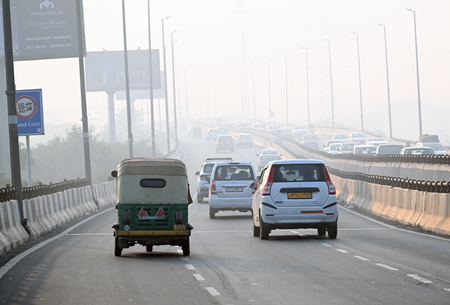
The air quality in Delhi saw a slight improvement as the Air Quality Index (AQI) dropped to 292, categorizing it as ‘poor.’ This positive change follows a period of ‘severe’ air quality, with the AQI peaking at 412 on December 23. Over the last few days, pollution levels have gradually decreased across various parts of the city.
Data from the Central Pollution Control Board’s Sameer mobile application indicated that, as of 6.05 a.m., three monitoring stations reported air quality in the ‘moderate’ category. These stations included Lodhi Road-IITM at 160 AQI, Lodhi Road-IMD at 194, and Najafgarh at 188. Several other stations recorded ‘poor’ air quality levels, such as Aya Nagar (212), CRRI Mathura Road (265), and Dwarka Sector 8 (282).
Despite the improvements, some monitoring stations continued to report ‘very poor’ air quality. Areas like Anand Vihar (377), Bawana (363), and Vivek Vihar (361) recorded some of the highest pollution levels in the city. Following the better air quality, the Commission for Air Quality Management (CAQM) lifted the Graded Response Action Plan (GRAP) Stage-IV restrictions in the Delhi-National Capital Region (NCR) on December 24.
Air quality in the surrounding NCR areas varied. Bahadurgarh in Haryana recorded a ‘very poor’ AQI of 301, while Gurugram’s overall AQI was at 270, falling into the ‘poor’ range. In Uttar Pradesh, Ghaziabad registered an AQI of 344, with all monitoring stations reporting ‘very poor’ air quality. Delhi’s decision to restrict entry to only Bharat Stage (BS) 6 vehicles aimed to reduce vehicular emissions, a significant contributor to the region’s pollution, especially during winter.
