


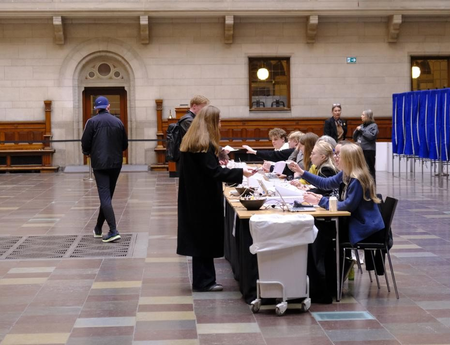
Denmark’s Social Democrats emerged as the largest party in the recent parliamentary election. However, both the left-leaning red bloc and the right-leaning blue bloc fell short of securing a clear majority in the Folketing, the Danish parliament.
The preliminary results from Denmark proper revealed that the Social Democrats captured about 21.9% of the vote, earning 38 seats, a decrease of 12 seats from the previous election. The Socialist People’s Party followed with 20 seats, while Venstre, the Liberal Party of Denmark, obtained 18 seats. Additionally, Liberal Alliance and the Danish People’s Party each secured 16 seats.
In the Denmark proper tally, the red bloc clinched 84 seats, while the blue bloc garnered 77 seats. With a majority in the 179-seat Folketing requiring 90 seats, the Moderates, who won 14 seats, are anticipated to play a crucial role in the forthcoming government formation negotiations.
Prime Minister Mette Frederiksen, speaking post-election, expressed readiness to lead the negotiations and continue governing the country. She acknowledged the challenges ahead, recognizing that forming a new government would not be a straightforward task. In Denmark’s multi-party parliamentary system, coalition or minority governments often result from such elections, with party leaders engaging in talks to determine the government’s composition.
