


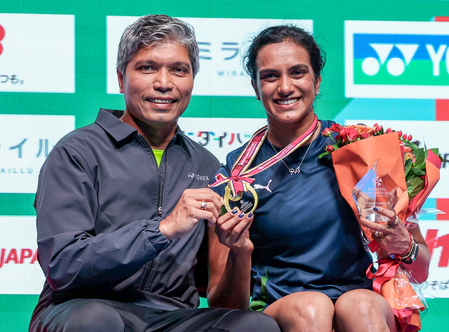
New Delhi, Aug 16 (IANS) PV Sindhu’s improved consistency in 2026 has been the product of work away from the spotlight as much as of what she has produced on court, with the Indian revealing that her sports-science, strength and conditioning and physiotherapy teams have played a central role in preparing her for the World Championships in New Delhi.
After dealing with the physical demands of a long professional career, Sindhu said her team has focused on understanding what her body requires, when she can push herself and when recovery needs to take priority.
“I’ve had the sports science, the physio and the trainer. We all came together. We sat down and noted down what is required and what is needed. We discussed it with the coach and had to improve on those things. And all of that together played a very major role. It’s not just the tournaments or people seeing us when we play a match, but it’s behind the scenes what we do, what is required, and how smartly we adapt.
“Because sometimes your body might not cooperate when you’re playing, and you have to make sure you get that rest. So, we need to take those decisions very carefully to make sure that you’re at your 100% peak at the right time. So, we’ve been doing this correctly and rightly, and that’s what made this difference and this change,” Sindhu said in the pre-match press conference at the Indira Gandhi Stadium on Sunday.
The approach has been built around prevention as much as recovery. Sindhu said modern monitoring tools have helped her team assess fatigue and physical readiness before deciding how much load she should take.
“Yeah, as I mentioned, it was very important for me to have a sports science team around me, including the S&C and physio, and, of course, the coach is always there. He heads the strength and conditioning, so it’s very important to build around that. Sometimes your body isn’t at 100%, but you still push at times, right? And injuries don’t tell you when they’re coming; they just happen. So, before that, what precautions do you take, and how do you adjust smartly?
“You have all these gadgets now to record your strength, how tired you are, and whether you can push yourself or not. So, these are metrics you use to make sure , maybe tomorrow it’s a different kind of training you do. These are the small things you change, and that’s what helped me. Yeah, we’re working towards that, and physically, it’s been quite good. I’m able to see the changes in my game and my movement. So, I’m happy that it’s going the right way,” she added.
The Indian will also have to contend with an evolving women’s singles game. Sindhu believes the modern game demands greater patience and the ability to manage long rallies, while conditions can require constant adjustments during a match.
“There have been quite some changes, I would say, in terms of the game and in how you think and strategise. Overall, I feel the game, badminton, and the sport itself have changed. Earlier, women’s singles was more attacking and faster-paced. But now it’s more about long rallies and staying on court for longer periods of time. So you need a lot of patience in that respect.
“But when you look back, since then until now, as a person, in terms of experience, there have been a lot of changes. And I feel now I am much more experienced. Irrespective of playing the sport for a longer period of time, I am definitely much more experienced in terms of how to deal with things on court. Sometimes there is drift. And sometimes, how do you control the shuttle? It might not go your way all the time. So, how do you adjust and make sure it is convenient for you?,” Sindhu stated.
That experience will be particularly useful in New Delhi, where Sindhu will have to adapt not only to opponents but also to the conditions and the demands of a tournament in front of a home crowd. She also believes the sport itself will continue to evolve, including with the proposed 15-point scoring format, which she expects to place an even greater premium on fast starts.
“It is going to be very challenging, in fact, because if it was 21 points, it is still tight. You are down 7-0, and you still have time to score. Whereas in 15, if the 7 points are done, almost the match is done. So it is going to be very challenging, and you need to be on your feet from the start. It is going to be hectic, and you need to be quick on your feet from the first point.
“You can’t take it easy and then think that, I might come back or I will come back. So, with the 15-point scoring format, you need to be on your feet from the beginning, alert on your feet every single time.
“But looking at the younger generation, there is some good talent. But at the same time, we, with our experience, see that the game is changing. The game is evolving all the time. In fact, it was a faster game then, and now it’s much slower and longer, with a lot more rallies.
“And maybe in 15 points, it might become different, where you have to be quick on your feet, and there might be some short, quick, fast rallies. So, you have to get adapted to it. And of course, I am happy that I get to see a lot of changes in sport. But at the same time, it is always good. I mean, anything is good for Indian sport because you have to get used to it. Because that is how sport is…game changes, scoring changes,” she expressed.
–IANS
vi/bc
