


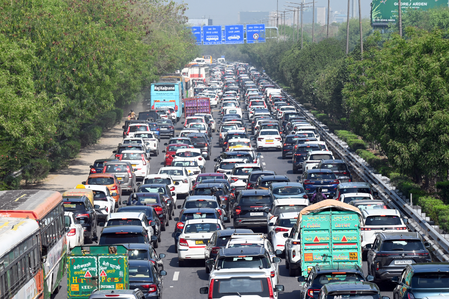
Cumulative domestic two-wheeler sales in India saw a significant 22% year-on-year increase to 33.6 lakh units during April-June 2026. Similarly, passenger vehicle sales within the country also experienced a rise of about 25% to reach 12.7 lakh units, as per a recent report. The industry is anticipated to sustain this growth momentum in the fiscal year 2027.
The positive outlook for the industry in FY27 is underpinned by factors such as enhanced consumer affordability, a growing adoption of electric vehicles (EVs), and the introduction of new vehicle models. These growth drivers are expected to counterbalance the impact of price escalations by original equipment manufacturers (OEMs) due to fluctuating raw material costs amid economic uncertainties.
Furthermore, the report highlighted that two-wheeler exports exhibited improved performance across international markets, while domestic commercial vehicle sales surged by 18% year-to-date to reach 2.52 lakh units. The increase in domestic commercial vehicle sales was attributed to a robust performance driven by an early replacement cycle and a favorable freight demand scenario.
On the other hand, three-wheeler domestic wholesales recorded a year-to-date increase to 1.55 lakh units, and tractor sales witnessed a notable 19% climb. The industry foresees several potential growth catalysts for the demand of two-wheelers and three-wheelers, including government-led consumption initiatives, a rise in rural demand, and the launch of new vehicle models.
Looking ahead, the industry’s overall outlook for FY27 remains optimistic, buoyed by strong demand projections, a surge in EV adoption, and stable income tax rates. However, these positive forecasts may be somewhat offset by adverse macroeconomic conditions and the high base effect from the previous financial year.
In June 2026, domestic two-wheeler OEM sales observed a year-on-year increase of approximately 13%, although they dipped by 3% on a month-on-month basis. Conversely, three-wheeler sales reported a 63% year-on-year growth and a 10% month-on-month increase. Commercial vehicle dispatches are expected to maintain a positive trajectory in FY27, supported by enhanced fleet utilization and early replacement demand. Nevertheless, the growth pace could be hindered by geopolitical tensions and potential disruptions in raw material supply chains, impacting exports and potentially causing production slowdowns in the short term.
