


The European Union (EU) and India have agreed to enhance their trade and technology relations, establishing a formal partnership that positions India as the second country, after the United States, to achieve this level of collaboration with Brussels. This move underscores Brussels’ aim for India to play a more significant role in its supply chains, technology sector, and broader economic strategy.
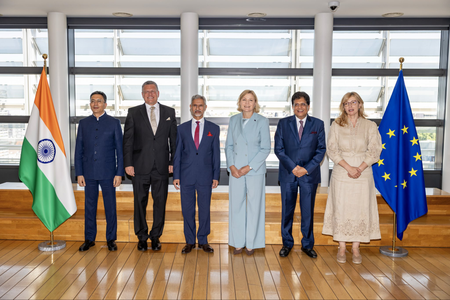
The EU–India Trade and Technology Council convened in Brussels, with the participation of three Indian ministers and three members of the European Commission. India’s delegation included External Affairs Minister S. Jaishankar, Commerce and Industry Minister Piyush Goyal, and Minister of State for Electronics and Information Technology Jitin Prasada. The European team was led by Henna Virkkunen, Maros Sefcovic, and Ekaterina Zaharieva.
Initiated by European Commission President Ursula von der Leyen and Prime Minister Narendra Modi in 2022, the council is set to expand its scope by the year’s end. Plans include discussions on India’s involvement in the Horizon Europe research program, the establishment of a joint center for electric vehicle charging technology, the launch of a high-tech start-up alliance, and increased collaboration in areas like semiconductors, artificial intelligence, supercomputers, quantum technology, and 6G networks.
Both sides have also committed to closer cooperation on pharmaceuticals, food, and energy supply chains. The EU sees India as a key component of its future economic strategy, marking a significant diplomatic and commercial investment by Brussels. This partnership acknowledges the evolving global economy, recognizing India as a major power with its own interests, not merely a subordinate ally.
Brussels is particularly interested in India’s expanding industrial capabilities, sizable population, and strategic autonomy from major global powers like Washington, Beijing, and Moscow.
