


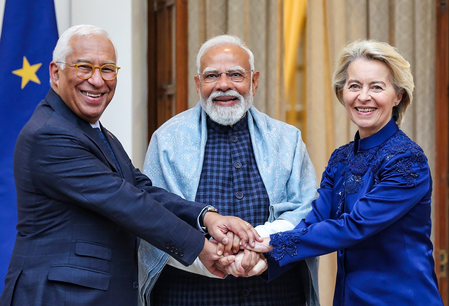
The EU-India free trade agreement, described as the “mother of all deals,” signifies a shift in the global order away from US dominance. This trade deal, involving the European Commission, European Council, and Indian Prime Minister Narendra Modi, aims to unite around two billion consumers and a quarter of the world’s GDP. The partnership hints at increased alignment on multilateral institutions, security, defense, research, and connectivity, including a focus on the Indo-Pacific region.
As the US retracts its global presence, the Indo-Pacific region emerges as a new arena for EU collaboration, previously dominated by the US. The evolving post-US world is becoming evident, with the substantial EU-India trade agreement being a prominent example. Recent trade developments include Brussels’ agreement with the South American Mercosur bloc, along with India’s deals with the UK and New Zealand.
The EU-India trade deal’s conclusion last month may have spurred the US to expedite its trade negotiations with India, as suggested by a South Asia expert at the Asia Society in New York. The timing of the US-India trade discussions following the EU agreement is notable, indicating a strategic response to the evolving global trade landscape.
