


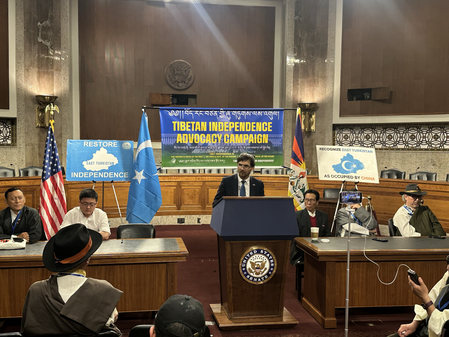
Several exiled Tibetan and East Turkistani representatives gathered at the United States Congress to advocate for the independence of Tibet and East Turkistan from what they termed as “Chinese colonial occupation.” The event, which took place at the Dirksen Senate Office Building on May 15, saw participation from groups like the Tibetan Patriots for Independence and the East Turkistan National Fund. Concerns were raised regarding the oppressive actions of Chinese authorities in both regions.
During the advocacy event, the representatives engaged with the offices of six senators and more than twenty House members to highlight their cause. ETNM President Salih Hudayar criticized China, labeling it as a colonial empire rather than a nation-state. He emphasized the importance of addressing the root cause of the Chinese occupation of East Turkistan and Tibet, calling for global recognition and support for their independence.
Hudayar stressed the necessity of independence for safeguarding the human rights and survival of their people, asserting that it is the only viable solution. He urged the United States and other freedom-loving nations to acknowledge East Turkistan as an occupied territory, extend support for the independence of both East Turkistan and Tibet, and assist in ending China’s colonial rule and atrocities in the regions.
Tibetan Patriots for Independence also presented a formal petition requesting backing for Tibet’s independence and the official designation of February 13 as Tibet Independence Day. The petition underscored the opposition to China’s assimilation policies, the protection of Tibetan culture and religion, the release of Tibetan political detainees, and the preservation of Tibet’s environment. Tenzin Wangdu, leader of Tibetan Patriots for Independence, appealed to the U.S. Congress to stand in solidarity with Tibetans for their freedom and rights.
As the U.S. marks 250 years of independence, the ETNM highlighted the prolonged struggles of East Turkistan and Tibet under Chinese rule. They invoked the Captive Nations Law, urging the U.S. to support nations striving for freedom and independence, with East Turkistan and Tibet among those in need of solidarity.
