


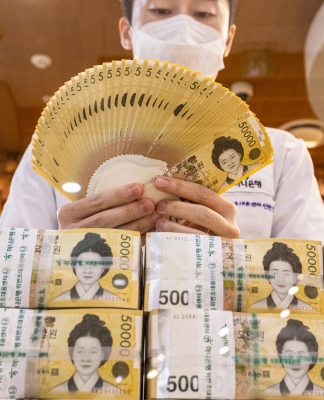
Experts have noted the Korean won’s annual average against the US dollar at 1,420, with financial authorities increasing verbal intervention to halt the won’s decline. The won closed at 1,440.3 against the dollar on Friday, the lowest since November 4, as reported by Seoul Money Brokerage Services. In response to the won’s weakness, financial authorities’ verbal intervention led to a significant rise in the won’s value against the dollar last week.
A new psychological resistance level is being observed, curbing the won-dollar exchange rate’s upward momentum. Baek Seok-hyun, an economist at Shinhan Bank’s S&T Center, highlighted the government’s stabilization efforts, expected to hold significance until year-end. Predictions suggest the won-dollar exchange rate could range between 1,400 and 1,420 by the end of the year.
Economist Lim Hwan-yeol from Woori Bank forecasts the year-end won-dollar exchange rate to be around 1,440, citing the likelihood of export companies injecting their dollar reserves into the market. The year-end won-dollar exchange rate holds importance for companies and financial institutions in evaluating their foreign-currency-denominated liabilities. Notably, the highest year-end won-dollar exchange rate was recorded during the 1997 financial crisis at 1,695 won per US dollar.
South Korean stocks closed higher on Friday, driven by significant gains in major tech shares like Samsung Electronics and SK hynix. The local currency strengthened against the US dollar amidst efforts to stabilize the foreign exchange market. The benchmark Korea Composite Stock Price Index (KOSPI) rose by 21.06 points, or 0.51 percent, closing at 4,129.68. Trading volume reached 502.7 million shares worth 16 trillion won (US$11.1 billion), with more losers than winners.
